

 TIMEBUCKS
Low minimum
payout of just
$3 — start
earning today!
Kenya has over 2,969 accredited TVET institutions as of 2025/2026, but the best are the 30 National Polytechnics at the top of the tier — led by Eldoret National Polytechnic, Kabete National Polytechnic, and Nairobi National Polytechnic. Government-sponsored students pay a standard KES 56,420 per year at most public polytechnics, with the government contributing KES 30,000 in capitation and students paying the remaining KES 26,420. The sector is mid-transition to a fully Competency-Based Education and Training (CBET) model — the most significant TVET reform in Kenya’s history.
Why TVET Is Kenya’s Smartest Education Investment in 2026
Kenya’s TVET sector has just come through its most productive growth phase in decades. Between 2022/23 and 2024/25, the number of TVET institutions expanded from 2,401 to 2,969 — a 24% increase — while enrolment surged by 63.8% to reach 565,842 trainees. The government has recruited 3,300 new trainers, completed 30 new institutions, and trained 11,600 existing trainers in the new CBET pedagogy.



This growth is not accidental. It responds directly to Kenya’s documented skills shortage — particularly in engineering, construction, ICT, healthcare, hospitality, and agribusiness — sectors that drive Vision 2030, the Big Four Agenda, and the Bottom-Up Economic Transformation Agenda.
Three facts define TVET’s strategic importance in 2026:
First, the shift to CBET means TVET graduates are now assessed on what they can do rather than what they know. Employers across East Africa increasingly prefer job-ready CBET graduates over theoretically trained candidates who need significant workplace orientation.
TIMEBUCKS
Low minimum
payout of just
$3 — start
earning today!
Second, TVET remains the most accessible and affordable higher education pathway in Kenya. With KUCCPS placement, government capitation, and HELB loans, a student can pursue a two or three-year diploma at a national polytechnic for as little as KES 26,420 out-of-pocket per year — after government and HELB contributions are factored in.

Third, the pathway from TVET diploma to university degree is now formally established. Diploma holders with Credit or Distinction can transfer directly into second or third year of a related degree programme at most Kenyan universities.
How Kenya’s TVET System Is Structured (2026)
Before reviewing specific institutions, it helps to understand the TVET tier system — because not all TVET colleges are equal, and the tier determines quality, facilities, and the employment weight of your qualification.
The Five-Tier TVET Structure
Tier 1 — National Polytechnics (NPs) The flagship TVET institutions. Currently 30 national polytechnics in Kenya, each offering a broad range of diploma, certificate, and artisan programmes. They have the best facilities, the broadest course offerings, and the strongest industry linkages. These are the top-ranked institutions in every national TVET survey.
Tier 2 — Technical Training Institutes (TTIs) Mid-level public institutions offering certificate and diploma programmes. There are several dozen TTIs across Kenya’s counties. Quality varies more than at polytechnics, but strong TTIs produce well-regarded graduates.
Tier 3 — Technical and Vocational Colleges (TVCs) County-level TVET colleges. Many were upgraded from older vocational centres. Course offerings are narrower, but fees are low and geographical reach is high.
Tier 4 — Vocational Training Centres (VTCs) Community-level artisan training. Entry is open to anyone. The focus is on practical trades — carpentry, masonry, tailoring, motor mechanics at basic level. Fees are lowest here.
Tier 5 — Kenya School of TVET (KSTVET) A unique institution in Gigiri, Nairobi that exclusively trains TVET trainers and educators. KSTVET does not train the general public for trades — it trains the teachers who teach trades. It is the leading TVET trainer education college in Eastern and Central Africa.
Key Regulatory Bodies
TVETA (Technical and Vocational Education and Training Authority): Established under the TVET Act 2013, TVETA registers, licenses, and accredits all TVET institutions. Verify any institution at tveta.go.ke.
TVET CDACC (Curriculum Development, Assessment and Certification Council): Develops and approves the competency-based curricula used across the TVET sector. Also awards certificates under the CBET framework.
KNEC (Kenya National Examinations Council): Examines KNEC-track diploma and certificate courses — the traditional examination pathway alongside the newer CBET certification.
KUCCPS: Manages placement of government-sponsored students into KUCCPS-listed TVET programmes. Confirm institution KUCCPS listing at kuccps.net.
The Best TVET Colleges in Kenya 2026: Full Rankings and Reviews
Tier 1 — National Polytechnics (Top of the TVET Hierarchy)
1. Eldoret National Polytechnic (TENP) — #1 Ranked
County: Uasin Gishu
Regulator: TVETA (Reg. No. TVETA/PUBLIC/NP/0005/2016)
Website: tenp.ac.ke
Eldoret National Polytechnic is consistently ranked the best TVET institution in Kenya. The Timely Kenya 2025 national TVET survey ranked Eldoret National Polytechnic at number one, followed by Kabete and Nairobi national polytechnics. The institution is recognised as a national benchmark in TVET quality and has received endorsement from major industry partners including Safaricom, ABSA Bank, and the WorldSkills competition network.
Located approximately 5 kilometres from Eldoret town along the Eldoret–Kapsabet Road, TENP operates multiple departments and runs intakes in January, May, and September. It is fully KUCCPS-listed.
Key Departments and Selected Courses:
| Department | Diploma Programmes | Certificate / Artisan |
|---|---|---|
| Electrical & Electronics | Diploma in Electrical and Electronics Engineering (KNEC / City & Guilds) | Craft in Electrical and Electronics Engineering |
| Mechanical | Diploma in Mechanical Engineering | Craft in Mechanical Engineering |
| Building & Civil | Diploma in Building Technology | Craft in Building and Civil Works |
| ICT | Diploma in ICT (KASNEB), Diploma in Software Development (City & Guilds) | Craft in ICT Technician (KASNEB) |
| Business | Diploma in Accounting Technician (KASNEB), CPA Part I | Craft in Business Management |
| Hospitality | Diploma in Catering and Accommodation | Certificate in Food and Beverage |
| Medical Laboratory | Diploma in Medical Laboratory Technology (KMLTTB-accredited) | — |
Fees (2025/2026 — KUCCPS Students):
The total fee payable per year is KES 56,420. The government will pay KES 30,000 for each KUCCPS student. The balance of KES 26,420 shall be paid directly by the parent to the institution or may be raised by applying for a loan from the Higher Education Loans Board (HELB).
Additional charges:
- Caution money (new students): KES 500
- Registration fee (new students): KES 500
- KNEC practical fees for hospitality courses: KES 3,000–6,000 per programme
- Accommodation: Available on campus (confirm current rates at tenp.ac.ke)
Payment method: MPESA Paybill No. 304250 (enter KCSE year + 11-digit index number) or National Bank of Kenya, Eldoret Branch.
Entry requirements (selected courses):
- Diploma in Electrical & Electronics Engineering: C- overall with C- in English/Kiswahili, Physics or Mathematics
- Diploma in Medical Laboratory Technology: C- overall with C- in Chemistry, Biology, and D+ in Mathematics or Physics
- Most diploma courses: C- (Minus) mean grade
Location: P.O. Box 4461-30100, Eldoret, along Eldoret–Kapsabet Road
2. Kabete National Polytechnic — #2 Ranked
County: Kiambu
Regulator: TVETA
Website: kabetepoly.ac.ke
Consistently ranked among the top TVET institutions in Kenya, Kabete National Polytechnic is known for mechanical engineering, business, and ICT programs. Located along Kabete Road in Kiambu County, Kabete Polytechnic is one of Kenya’s oldest and most respected technical institutions — originally established in 1924 to offer craft courses including carpentry, masonry, plumbing, and secretarial studies.
The polytechnic has grown dramatically from its craft-training origins into a comprehensive national polytechnic offering diploma and certificate programmes across engineering, business, ICT, building, and applied sciences.
Key Strengths:
- One of Kenya’s longest-established TVET institutions, founded 1924
- Strong track record in Mechanical Engineering and Building Technology graduates
- Close proximity to Nairobi’s industrial and business sectors — strong employer linkages
- Medical Laboratory Technology diploma is KMLTTB-accredited
- KUCCPS-listed with government capitation
Fee Structure (2026):
Kabete National Polytechnic fee structure for 2026 covers Building and Civil Engineering, Electrical Engineering, ICT, Business, and Hospitality departments. The standard annual fee for KUCCPS-placed students follows the government-guided structure at KES 56,420.
Selected Departments:
- Building and Civil Engineering (Diploma and Certificate in KNEC)
- Electrical and Electronics Engineering
- Mechanical Engineering
- Information and Communication Technology
- Business and Entrepreneurship
- Hospitality and Tourism Management
- Medical Laboratory Technology (KMLTTB accredited)
Location: Along Kabete Road, Kiambu County (near Nairobi’s Westlands area)
3. Nairobi National Polytechnic — #3 Ranked
County: Nairobi
Regulator: TVETA
Website: nnp.ac.ke
One of the most established TVET institutions in Kenya, the Nairobi National Polytechnic is located in Nairobi’s economic heartland and offers a diverse range of programmes from electrical engineering to hospitality. Its Nairobi location gives graduates direct access to Kenya’s largest employment market and the most diverse industrial and commercial environment in the country.
The polytechnic offers courses across engineering, business, ICT, hospitality, and applied sciences, and has strong ties to Nairobi’s manufacturing, services, and hospitality sectors.
Entry requirement: C- (Minus) for most diploma programmes.
Location: P.O. Box 30630-00100, Nairobi
4. Kenya Coast National Polytechnic (KCNP) — Best on the Coast
County: Mombasa
Regulator: TVETA
Website: kenyacoastpoly.ac.ke
Kenya Coast National Polytechnic is the top-ranked TVET institution in coastal Kenya, known for maritime studies, tourism, hospitality, and electrical trades. Established in 1950 as Coast Technical High School, it now serves over 7,500 students across 10 teaching departments. It holds an extraordinary international profile for a public TVET college — with partnerships including North Island College (Canada) under the KBEST project, Huawei (HAINA programme), Oracle Academy, and Cisco Networking Academy.
KCNP also operates Mvita FM 106.2, a radio station that doubles as a practical training facility for media and journalism students.
Annual fee (KUCCPS students): KES 56,420 per term (one of the highest-cost structures among polytechnics — confirm latest rates at kenyacoastpoly.ac.ke)
Departments: Electrical and Electronics Engineering, Mechanical and Automotive Engineering, Building and Civil Engineering, ICT, Business and Media, Hospitality and Tourism, Medical Sciences, Applied Sciences, Fashion Design and Cosmetology, Secretarial and Liberal Studies.
Location: Majengo/Kisauni Road, Mvita, Mombasa
5. Sigalagala National Polytechnic — Best in Western Kenya
County: Kakamega
Regulator: TVETA
Website: sigalagalapoly.ac.ke
The institution is located in Sheywe, along the Kisumu–Kakamega Road and provides innovative industry-responsive technical skills training for sustainable development. Sigalagala National Polytechnic is a public institution founded in 1924 offering technical training courses at Diploma, Certificate, Artisan, and Higher Diploma levels. It is one of the oldest continuously operating technical training institutions in Kenya.
Sigalagala serves Western Kenya’s large student population with strong programmes in engineering, business, agriculture, and ICT.
Location: Sheywe, Kakamega County
6. Kisumu National Polytechnic — Best in Nyanza
County: Kisumu
Regulator: TVETA
Website: kisumupoly.ac.ke
Located along Technology Road in Kisumu City, Kisumu National Polytechnic serves over 6,000 students across diploma, certificate, bridging, and foundation courses. It is the leading TVET institution in Nyanza and western Kenya for electrical engineering, hospitality, and ICT training.
The polytechnic’s proximity to Lake Victoria and the region’s growing fishing, logistics, and tourism industries gives graduates a practical industry context that is unique in Kenya.
7. Rift Valley National Polytechnic — Best in the Rift
County: Nakuru
Regulator: TVETA
Website: rvnp.ac.ke
Rift Valley National Polytechnic is a post-secondary technical, industrial, vocational, and entrepreneurial training institution in Nakuru — one of Kenya’s fastest-growing cities. It is a direct outgrowth of the increasing demand for technical manpower attendant to Vision 2030, with a current enrolment of over 5,000 students.
The polytechnic offers diverse departments spanning engineering, business, hospitality, ICT, and applied sciences. It confirmed its annual fee at KES 67,189 for 2026/2027 (slightly above the standard KES 56,420 capitation-linked figure — confirm details at rvnp.ac.ke).
8. Meru National Polytechnic — Best in Mount Kenya Region
County: Meru
Regulator: TVETA
Website: merupolytechnic.ac.ke
Meru National Polytechnic serves Central and Eastern Kenya with a strong engineering, ICT, and agricultural technology focus. It has benefited from significant government infrastructure investment and is a well-regarded placement choice for students from Meru, Tharaka-Nithi, and Isiolo counties.
9. Kisii National Polytechnic — Strong in Kisii Region
County: Kisii
Regulator: TVETA
Website: kisiipoly.ac.ke
It is one of the best national polytechnics in Kenya, located in Kisii Town, serving students from Kisii, Nyamira, and surrounding counties. Kisii National Polytechnic offers a comprehensive range of engineering, business, ICT, and hospitality programmes.
10. Kenya School of TVET (KSTVET) — Unique Specialisation
County: Nairobi
Regulator: TVETA (Government)
Website: kstvet.ac.ke
KSTVET is in a category of its own. The Kenya School of TVET (formerly Kenya Technical Trainers College — KTTC) is the leading college in Eastern and Central Africa in technical trainer education. Established in 1978 through a partnership between the Government of Kenya and the Canadian government, KSTVET trains TVET educators — the teachers who then go on to teach in every other TVET institution in the country.
KSTVET is not for the general public seeking a trade qualification. Its audience is TVET professionals who want to qualify as TVET instructors, trainers, or curriculum developers.
Courses offered:
- Certificate in Instructor Training (requires Level 5 or Craft certificate)
- Diploma in Technical Trainer Education (requires Level 6 or Diploma)
- Continuous Professional Development (CPD) programmes for TVET practitioners
- Foreign Languages programmes (open to the general public)
- Capacity building in CBET pedagogy, curriculum development, and digital learning
KSTVET’s April 2026 intake is currently ongoing. Enrolment is open for both pre-service and in-service candidates.
Location: UN Avenue, Gigiri, Nairobi (adjacent to UNEP headquarters, along Limuru Road)
Other Notable Government TVET Colleges Worth Knowing
Nyandarua National Polytechnic (Nyandarua County) — Rapidly growing polytechnic in Central Kenya. Full courses and fees available at nyandaruanp.ac.ke.
Thika Technical Training Institute (Kiambu) — Distinguished by its dedication to satisfying the changing needs of many sectors. With more than fifty certificate and diploma programmes, including ICT, Library Studies, Civil Engineering, and Business Administration.
C. Kinyanjui Technical Training Institute (Nairobi) — One of Nairobi’s most established public TTIs, offering engineering, ICT, and business at competitive fees.
Rift Valley Technical Training Institute (RVTTI) (Uasin Gishu) — Strong polytechnic in the Eldoret region with confirmed annual fee of KES 67,189 for 2026/2027.
Railway Training Institute (Nairobi) — Specialised in transport and logistics training, with a vision to become the top training centre for the transport sector on the African continent.
Kenya Utalii College (Nairobi/Mombasa) — The premier hospitality and tourism training college in East Africa, having trained over 60,000 students. A specialised government college under the Ministry of Tourism.
Kenya Water Institute (KEWI) (Nairobi) — Specialised in water and sanitation training. Essential for students interested in water resources, water supply engineering, and environmental management.
Best Private TVET Colleges in Kenya 2026
Private TVET colleges play an important role in areas under-served by public polytechnics and for students who prefer smaller classes, flexible intakes, or specialised programmes.
Top Private TVET Colleges by Specialisation
For ICT and Technology:
| College | Location | Specialisation |
|---|---|---|
| Inceptor Institute of Technology | Hazina Towers, 18th Floor, Nairobi | ICT, cybersecurity, software skills |
| Moringa School | Nairobi | Software development, web design, data analysis |
| Institute of Software Technologies (IST) | Nairobi | ICT, software, established 1991 |
| NIBS Technical College | Nairobi (CBD, Thika Road, Ongata Rongai) | ICT, media, business, hospitality |
For Business and Professional Studies:
| College | Locations | Specialisation |
|---|---|---|
| ICS College (formerly EAICS) | Nairobi, Mombasa, Kisumu, Nakuru, Eldoret, Thika, Virtual | Business, Health, ICT, professional exams |
| Kenya Christian Industrial Training Institute (KCITI) | Eastleigh 2nd Avenue, Nairobi | Trades, business, general TVET since 1992 |
| Rifkins College | Digo Road, Mombasa | Business, ICT — KNEC and UK (ICM/ABMA) qualifications |
For Medical and Healthcare TVET:
| College | Location | Specialisation |
|---|---|---|
| GoCare Training Institute | Nairobi | Caregiving, health support, NITA, KNEC, AMCA (USA), SDC Canada certified |
| Imperial College of Medical and Health Sciences | Thika, Nakuru | Clinical Medicine, Nursing, Nutrition, Health Records |
TVET Courses in Kenya 2026: The Most Marketable Options
The following analysis is based on employer demand, government priority sectors, salary outcomes, and employment rates for 2026 graduates.
Diploma-Level Courses (Minimum C- at KCSE)
| Course | Why It’s Marketable in 2026 | Key Employers |
|---|---|---|
| Diploma in Electrical and Electronic Engineering | Power expansion, industrial automation, solar energy | Kenya Power, manufacturing plants, construction |
| Diploma in Medical Laboratory Sciences | Every health facility needs lab technologists | County hospitals, private clinics, NHIF network |
| Diploma in ICT / Software Development | Kenya’s digitalisation agenda, tech startup growth | Safaricom, banks, tech companies, self-employment |
| Diploma in Mechanical Engineering | Manufacturing, automotive, industrial machinery | Engineering firms, KBS, jua kali sector |
| Diploma in Civil Engineering / Building Technology | Affordable Housing Programme, road construction | National Construction Authority contractors |
| Diploma in Nursing (KRCHN) | Universal Health Coverage demand | All health facilities, NGOs, overseas recruitment |
| Diploma in Pharmacy Technology | Growing pharmacy network, new insurance facilities | Pharmacies, county hospitals, private clinics |
| Diploma in Catering and Hospitality Management | Tourism recovery, hotel expansion, cruise industry | Hotels, resorts, airline catering, self-employment |
| Diploma in Business Management / Accounting | Every sector needs business and finance professionals | Banks, NGOs, government, private firms |
| Diploma in TV and Film Production | Entertainment industry growth, digital content market | KBC, NTV, Citizen TV, independent content studios |
Certificate-Level Courses (Minimum D+ at KCSE)
| Course | Grade Required | Why It Works |
|---|---|---|
| Certificate in Electrical Installation | D+ | Permanent demand from construction and real estate |
| Certificate in Welding and Fabrication | D+ | Infrastructure projects, manufacturing, fabrication shops |
| Certificate in Automotive Engineering | D+ | Vehicle imports rising, shortage of qualified mechanics |
| Certificate in Refrigeration and Air Conditioning | C- | Low supply of qualified technicians, high household demand |
| Certificate in Fashion Design and Garment Making | D+ | Creative industry growth, export potential |
| Certificate in Building Technology / Masonry | D+ | Affordable Housing Programme drives sustained demand |
| Certificate in ICT | D+ | Digital literacy drives employment across all sectors |
Artisan-Level Courses (Open Entry — D- and Below or KCPE)
For students who scored below D at KCSE or hold only a KCPE certificate, artisan-level VTC programmes remain a credible, government-accredited entry point:
- Electrical Artisan
- Carpentry and Joinery
- Plumbing and Pipe Fitting
- Masonry
- Tailoring and Dressmaking
- Motor Vehicle Mechanics (basic)
- Hairdressing and Beauty Therapy
These are offered at Vocational Training Centres (VTCs) across all 47 counties, with annual fees as low as KES 5,000–20,000.
Read also: KUCCPS Placement Colleges (2026): Complete Guide to Government Sponsored College Courses in Kenya
What Is CBET and Why It Changes Everything for TVET Students in 2026
Competency-Based Education and Training (CBET) is reshaping how Kenya prepares its people for the job market. It is a bold shift away from traditional teaching models, focusing instead on what learners can do, not just what they know.
CBET has been championed in Kenya to bridge the gap between what is taught in training institutions and the real needs of the job market. The system is coordinated by TVET CDACC and regulated by TVETA.
How CBET Works
Every CBET course is built around competencies — clear statements of what a person should be able to do after training. These are developed by industry experts and approved by TVET CDACC. For example, in a course on Electrical Installation, competencies might include: “Install domestic electrical wiring” or “Troubleshoot basic electrical faults.”
Instead of covering everything in one long course, CBET breaks training into manageable modules. Students can earn certificates for each module and return later to continue. This allows flexibility, especially for working learners.
To pass, students must demonstrate skills through real or simulated tasks, documented in a Portfolio of Evidence that forms part of the final assessment. Nobody graduates by just passing a theory test.
CBET also supports Recognition of Prior Learning (RPL) — allowing skilled individuals such as jua kali artisans or Kenyans returning from abroad to gain formal certification without starting from scratch.
The Ministry of Education’s CBET Timeline
The Ministry of Education’s TVET Sub-Sector Report for FY 2026/27–2028/29 confirms that full implementation of CBET curricula and digital learning resources is a top government priority. Between 2022 and 2025, the government developed or reviewed 212 CBET curricula, introduced 23 digital CBET courses, and assessed over 265,000 candidates under the new framework.
The CBET full rollout was set for January 2026 — allowing flexible training and modular qualifications based on skills rather than just theory.
TVET Fees in Kenya 2026: What to Realistically Expect
| Institution Type | Annual Tuition (KUCCPS, KES) | Student Pays After Gov. Capitation | Accommodation (KES/year) |
|---|---|---|---|
| National Polytechnic (most) | 56,420 | 26,420 (gov. pays 30,000) | 15,000–35,000 |
| National Polytechnic (some, e.g., RVTTI) | 67,189 | 37,189 (gov. pays 30,000) | 12,000–30,000 |
| Technical Training Institute | 30,000–50,000 | Varies | 12,000–25,000 |
| Technical and Vocational College | 20,000–40,000 | Varies | Where available |
| Vocational Training Centre | 5,000–20,000 | Community-funded | Rarely available |
| Private TVET College | 60,000–150,000 | Full fees (no capitation) | Self-arranged |
Government capitation explained: For every KUCCPS-placed student, the government pays KES 30,000 per year directly to the institution. The student pays the remaining balance. This effectively reduces the out-of-pocket annual cost at most polytechnics to approximately KES 26,420 — making it among the most affordable technical training on the continent.
HELB TVET Loans: Students at accredited TVET institutions can borrow up to KES 60,000 per year from HELB, repayable after graduation when employed. Apply at helb.co.ke. At a polytechnic where you pay KES 26,420 out-of-pocket, a HELB loan fully covers tuition and contributes toward accommodation — a powerful combination.
Entry Requirements for TVET Courses in Kenya 2026
| Level | Programme Type | Minimum KCSE Grade |
|---|---|---|
| Artisan | Basic trade skills (VTC) | KCPE or any KCSE grade |
| Level 4 (Craft Certificate) | Short-cycle technical programmes | D+ (Plus) |
| Level 5 (Certificate) | Certificate-level TVET programmes | C- (Minus) |
| Level 6 (Diploma) | Diploma-level technical programmes | C- (Minus) |
| Level 7 (Higher Diploma) | Advanced specialised programmes | C (Plain) + relevant diploma |
A note on mature entry: TVETA regulations allow applicants who are 25 years of age or older to qualify for some programmes without meeting the standard KCSE grade, provided they can demonstrate relevant work experience. Confirm mature-entry eligibility directly with the institution.
How to Apply to a TVET College in Kenya 2026 (Step-by-Step)
Route 1: Via KUCCPS (Government-Sponsored — Recommended)
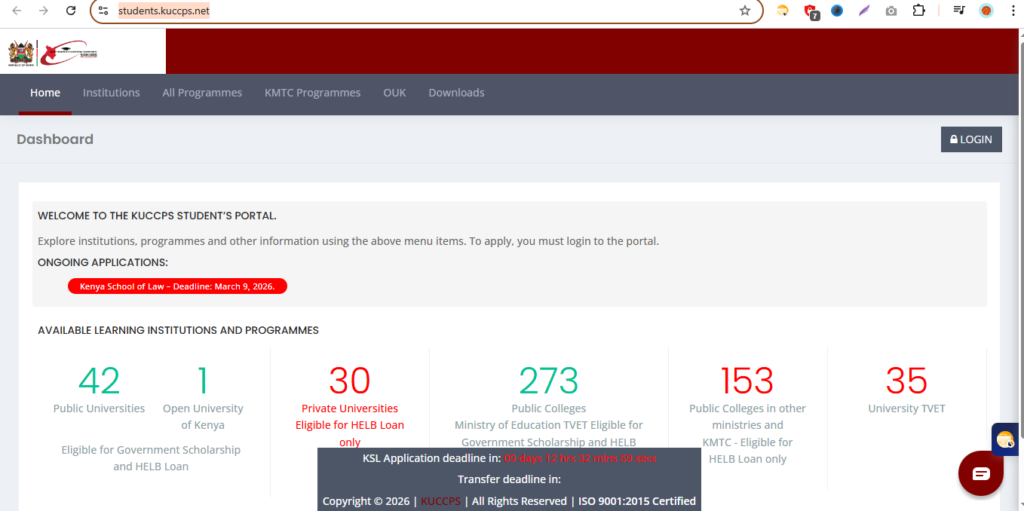
- Log into the KUCCPS student portal at students.kuccps.net using your KCSE index number and password.
- Navigate to TVET institutions and search for your preferred polytechnic and course.
- Select up to six course-institution combinations in order of preference.
- Submit your application before the published deadline. For the September 2026 intake, applications typically open in June/July after KCSE 2025 results are released.
- Await placement results via SMS and online portal.
- Download your admission letter and reporting date from the KUCCPS portal.
- Apply for HELB TVET loan at helb.co.ke — do this early, as processing takes time.
- Apply simultaneously for county government bursary and NG-CDF bursary from your local offices to further reduce costs.
- Report on the stated date with original KCSE certificate, national ID, birth certificate, and passport photographs.
Route 2: Direct Entry (Self-Sponsored)
- Visit the institution’s official website (confirm TVETA registration first).
- Confirm the programme you want is currently accredited for the intake you are targeting.
- Download and complete the application form, or apply via the institution’s online portal.
- Pay the application fee (typically KES 500–2,000).
- Submit with your KCSE certificate, national ID, and passport photos.
- Await admission confirmation and pay the first-year fees before the reported date.
- Apply for HELB and bursaries even as a self-sponsored student — eligibility is based on the course and institution, not how you applied.
TVET Graduate Career Outcomes and Salary Expectations (2026)
TVET graduates are known for immediate entry into employment or entrepreneurship because of practical, hands-on training. Here is a realistic picture of where TVET graduates in Kenya’s most popular fields end up:
| Field | Typical Starting Job | Monthly Salary Range (KES) | Entrepreneurship Potential |
|---|---|---|---|
| Electrical Engineering | Electrician, site technician, power technician | 25,000 – 60,000 | High — independent electrical contractors |
| ICT | ICT support, network technician, software developer | 30,000 – 80,000+ | Very High — freelancing, software firms |
| Mechanical Engineering | Mechanic, plant technician, maintenance engineer | 25,000 – 55,000 | High — own garage or workshop |
| Civil/Building Tech. | Site supervisor, building technician | 30,000 – 70,000 | High — construction contracting |
| Hospitality/Catering | Chef, F&B supervisor, hotel receptionist | 20,000 – 50,000 | Medium-High — catering, restaurant |
| Medical Lab Technology | Lab technologist | 35,000 – 55,000 | Medium — private lab set-up |
| Pharmacy Technology | Pharmacy technologist | 35,000 – 55,000 | Medium — private pharmacy (with partnership) |
| Business/Accounting | Accounts clerk, business administrator | 20,000 – 45,000 | Medium — consultancy, small business |
| Fashion Design | Tailor, fashion designer, retail | 15,000 – 40,000+ | Very High — own fashion label, workshop |
| Media / Film / TV | Camera operator, editor, reporter | 20,000 – 60,000+ | High — content creation, YouTube |
Pathway to degree from TVET: Diploma holders with Credit or Distinction can transfer directly into the second or third year of a related degree programme at most Kenyan public and private universities. This makes a TVET diploma not just a terminal qualification but a foundation for further academic advancement.
Pros and Cons of TVET Colleges vs. Universities in Kenya
| Factor | TVET College | University |
|---|---|---|
| Fees | KES 26,420/year net (polytechnic, KUCCPS) | KES 12,000–300,000+/year |
| Duration | 2–3 years for diploma | 4–5 years for degree |
| Entry grade | C- or D+ for most courses | C+ minimum |
| Focus | Hands-on, practical, industry-ready | Academic, theoretical |
| Employment speed | Fast — job-ready on graduation | May require additional experience |
| Entrepreneurship | Direct application of trade skills | More management/professional focus |
| Degree pathway | Yes — credit transfer after diploma | Continues to postgraduate |
| Prestige | Growing rapidly — CBET reform shifting perceptions | Traditionally higher prestige |
| HELB access | Yes — up to KES 60,000/year | Yes |
| Government sponsorship | Yes (KUCCPS) | Yes (KUCCPS) |
Frequently Asked Questions
1. Which is the best TVET college in Kenya?
Eldoret National Polytechnic (TENP) is Kenya’s top-ranked TVET institution based on the Timely Kenya 2025 national TVET performance survey, followed by Kabete National Polytechnic and Nairobi National Polytechnic. For coastal Kenya, Kenya Coast National Polytechnic (KCNP) in Mombasa is the leading institution. For Western Kenya, Sigalagala National Polytechnic and Kisumu National Polytechnic are the most respected. The best TVET college for you depends on your location, course of interest, and career goals.
2. How much are TVET college fees in Kenya in 2026?
For government-sponsored (KUCCPS-placed) students at most National Polytechnics, the total annual fee is KES 56,420. The government pays KES 30,000 in capitation, leaving the student responsible for KES 26,420 per year. Some polytechnics charge KES 67,189 (e.g., Rift Valley National Polytechnic). Additional fees for accommodation, registration, and course-specific materials apply separately. HELB TVET loans of up to KES 60,000 per year are available to cover costs.
3. What are the most marketable TVET courses in Kenya in 2026?
Based on employment demand, salary outcomes, and alignment with government priority sectors, the most marketable TVET courses in Kenya in 2026 are: Diploma in Electrical and Electronic Engineering, Diploma in Medical Laboratory Sciences, Diploma in ICT/Software Development, Diploma in Nursing (KRCHN), Diploma in Mechanical Engineering, Diploma in Civil Engineering/Building Technology, and Diploma in Pharmacy Technology. At certificate level: Electrical Installation, Automotive Engineering, and Refrigeration and Air Conditioning are consistently in high demand.
4. What grade do I need to join a TVET college in Kenya?
For diploma-level courses at polytechnics and TTIs, the minimum KCSE mean grade is C- (Minus). For certificate-level courses, the minimum is generally D+ (Plus). Artisan courses at VTCs are accessible to anyone with a KCPE certificate or any KCSE grade. Some institutions have higher requirements for competitive programmes — always confirm the specific grade requirements for your chosen course directly with the institution or via the KUCCPS portal.
5. What is CBET and how does it affect TVET students in 2026?
CBET (Competency-Based Education and Training) is Kenya’s new TVET curriculum model, replacing the older examination-only approach. Under CBET, students are assessed on practical skills demonstrations rather than theory exams alone. Training is modular — you can earn certificates for completed modules and return later to finish. Assessments are documented in a Portfolio of Evidence. CBET also supports Recognition of Prior Learning (RPL), allowing experienced workers to gain formal certification without restarting from scratch. Full CBET rollout was set for January 2026.
6. Are TVET diplomas recognised by employers and universities in Kenya?
Yes. TVET diplomas from TVETA-accredited institutions examined by KNEC or certified by TVET CDACC are nationally recognised by employers across Kenya and many regional employers. Many professional bodies — including KMLTTB, NCK, PPB — accept TVET diplomas for professional registration. Universities also recognise TVET diplomas for credit transfer purposes, admitting diploma holders directly to second or third year of a related degree programme, subject to performance and relevance.
7. Can I get a HELB loan for a TVET college?
Yes. Students at TVETA-accredited TVET institutions can borrow up to KES 60,000 per year from the Higher Education Loans Board (HELB). Apply at helb.co.ke after receiving your admission letter. The loan is repayable after graduation when you secure employment. HELB TVET loans are available to both KUCCPS-placed students and self-sponsored students at eligible institutions.
8. How many TVET colleges are there in Kenya?
As of the latest Ministry of Education TVET Sub-Sector Report, Kenya has 2,969 accredited TVET institutions — up from 2,401 in 2022/23, representing a 24% expansion driven by the government’s TVET growth agenda. These include 30 National Polytechnics, hundreds of Technical Training Institutes, Technical and Vocational Colleges, and thousands of Vocational Training Centres at the community level. All institutions are regulated by TVETA and must appear on the TVETA register to legally operate.
Final Verdict
Kenya’s TVET sector in 2026 is not what it was five years ago. The government’s sustained investment — 3,300 new trainers, 30 new institutions, 63.8% enrolment growth, and the CBET reform — has produced a system that is genuinely competitive, increasingly respected by employers, and dramatically more accessible than university education in terms of both cost and entry requirements.
The best choice among Kenya’s TVET colleges depends on your region, your career goals, and the specific industry you want to enter. What does not vary is the advice on process: apply through KUCCPS to access government capitation, submit your HELB application early, apply for county bursaries simultaneously, and verify TVETA registration before paying any fees.
For students who scored C- or below at KCSE, TVET is not a compromise — it is the most direct route to employment, entrepreneurship, and long-term career development available in Kenya today.
Read also:
- KUCCPS Placement Colleges (2026): Complete Guide to Government Sponsored College Courses in Kenya
- Teaching Colleges in Kenya 2026: Full Guide to TTCs, Courses, Fees, and TSC Employment
- Aviation Colleges in Kenya 2026: Pilot Training, Cabin Crew, Air Traffic Control & More
- Hospitality Colleges in Kenya (2026): Best Institutions for Hotel Management, Catering & Tourism
TIMEBUCKS
Low minimum
payout of just
$3 — start
earning today!