Choosing the right university course is one of the most important decisions a Kenyan student will ever make. The University of Nairobi (UON) — the country’s oldest and largest public university — offers over 300 academic programmes across nine faculties. Yet, many students and parents struggle to find clear, accurate information about UON course requirements, KUCCPS cluster points, and the application process.
This guide covers everything you need to know about University of Nairobi courses and requirements for the 2026 academic year: the full list of degree programmes by faculty, minimum KCSE grades, cluster points, approximate fees, and step-by-step guidance on how to apply. Whether you are a Form Four leaver, a parent supporting your child, or a mature student, this article gives you the information to make a confident and well-informed choice.


1. What Is the University of Nairobi?
What is the University of Nairobi? The University of Nairobi (UON) is Kenya’s premier public university, established in 1956 and granted full autonomy in 1970. It is the largest university in the country with seven campuses, over 300 academic programmes, and approximately 84,000 enrolled students.
The University of Nairobi was established in 1956 and became a fully independent institution in 1970, following the break-up of the University of East Africa. It is a body corporate established by an Act of Parliament (Cap 210 of the Laws of Kenya), making it Kenya’s pioneer institution of university education.
Today, UON is ranked among the top universities in Africa and features in the QS World University Rankings. It operates from its main campus on University Way in Nairobi, alongside six other campuses including Chiromo, Upper Kabete, Kikuyu, Mombasa, Kisumu, and Parklands. Its strong research culture, qualified faculty, and wide range of programmes make it the first choice for thousands of Kenyan students every year.
2. Faculties and UON Courses List
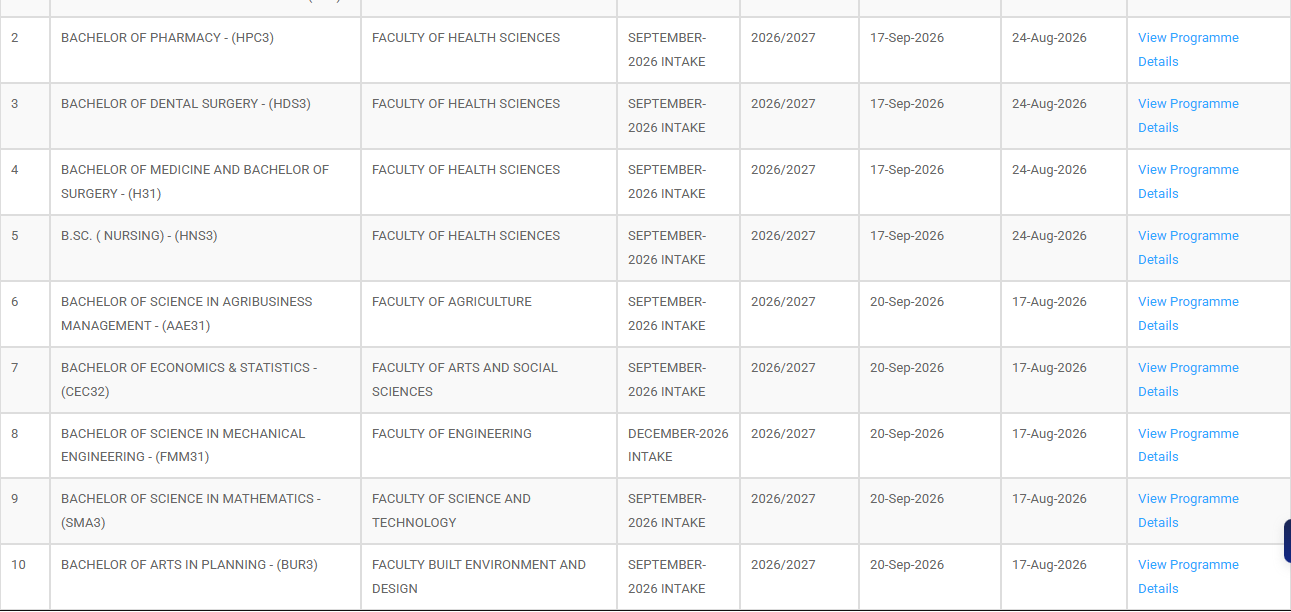
The University of Nairobi organises its programmes into nine main faculties. Below is a summary of the key degree programmes offered under each faculty. This is not an exhaustive list — UON offers over 300 programmes in total. Always verify current offerings on the official UON website at www.uonbi.ac.ke.
Faculty of Arts and Social Sciences
- Bachelor of Arts (BA) — with various subject combinations
- Bachelor of Arts in Linguistics and Languages
- Bachelor of Arts (Design)
- Bachelor of Arts in Film and Theatre Studies
- Bachelor of Science in Sociology
- Bachelor of Science in Psychology
Faculty of Business and Management Sciences
- Bachelor of Commerce (BCom)
- Bachelor of Science in Actuarial Science
- Bachelor of Science in Finance
- Bachelor of Science in Accounting
- Bachelor of Real Estate
- Bachelor of Science in Economics
Faculty of Engineering
- BSc in Civil Engineering
- BSc in Electrical and Electronic Engineering
- BSc in Mechanical Engineering
- BSc in Environmental and Biosystems Engineering
- BSc in Microprocessor Technology and Instrumentation
Faculty of Science and Technology
- BSc in Computer Science
- BSc in Mathematics
- BSc in Physics
- BSc in Chemistry
- BSc in Astronomy and Astrophysics
- BSc in Statistics and Programming
- BSc in Biochemistry
Faculty of Health Sciences (School of Medicine)
- Bachelor of Medicine and Bachelor of Surgery (MBChB) — 6 years
- Bachelor of Pharmacy (BPharm)
- Bachelor of Science in Nursing
- Bachelor of Dental Surgery (BDS) — 5 years
- Bachelor of Science in Medical Laboratory Sciences
- Bachelor of Science in Physiotherapy
Faculty of Agriculture
- BSc in Agriculture
- BSc in Agricultural Economics
- BSc in Agribusiness Management
- BSc in Food Science and Technology
- BSc in Food Science, Nutrition and Dietetics
- BSc in Wildlife Management and Conservation
- BSc in Fisheries and Aquaculture Management
- BSc in Range Management
Faculty of Veterinary Medicine
- Bachelor of Veterinary Medicine (BVM) — 5 years
Faculty of Law
- Bachelor of Laws (LLB) — 4 years
Faculty of Education
- Bachelor of Education (Arts) — B.Ed (Arts)
- Bachelor of Education (Science) — B.Ed (Science)
- Bachelor of Science in Agricultural Education and Extension
- Bachelor of Education (ICT)
In addition to these undergraduate programmes, UON offers a wide range of postgraduate (Masters and PhD) degrees as well as diploma and certificate courses through its School of Continuing and Distance Education (SCDE).
3. UON Course Requirements: What You Need to Know
What are the minimum requirements for UON? The minimum entry requirement for all undergraduate degree programmes at the University of Nairobi is a KCSE mean grade of C+ (plus). However, most competitive programmes — including Medicine, Engineering, and Law — require significantly higher grades, specific subject combinations, and strong cluster points.
General Minimum Requirements
For government-sponsored (Module I) students, admission to UON degree programmes goes through the Kenya Universities and Colleges Central Placement Service (KUCCPS). The baseline requirements are:
- KCSE Mean Grade: C+ (plus) or above
- Meeting the specific cluster subject requirements for your chosen course
- Achieving a cluster weight (cut-off point) at or above the UON threshold for that programme
For self-sponsored (Module II / Parallel) students, UON also accepts direct applications through its online portal at application.uonbi.ac.ke. The academic grade requirements remain the same, but students pay higher tuition fees.
Subject-Specific Requirements by Course Category
Different courses at UON require strong performance in specific KCSE subjects. Here is a summary:
| Course Category | Key Cluster Subjects Required | Min. Mean Grade |
|---|---|---|
| Medicine (MBChB) | Biology, Chemistry, Maths/Physics, English/Kiswahili | B+ and above |
| Engineering | Mathematics, Physics, Chemistry, English/Kiswahili | B plain and above |
| Law (LLB) | English, History/CRE/IRE, Kiswahili, any Social Science | B+ and above |
| Computer Science | Mathematics, Physics, English, any Science | B plain and above |
| Nursing | Biology, Chemistry, Maths/Physics, English/Kiswahili | C+ and above |
| Commerce / Business | Mathematics, English/Kiswahili, any two Business subjects | C+ and above |
| Education (Arts) | Two teaching subjects, English, one Social Science | C+ and above |
| Agriculture | Biology, Chemistry, Maths/Physics, English/Kiswahili | C+ and above |
Important: The above grades are general guidance. Actual placement depends on your calculated KUCCPS cluster weight and competition for available slots. Always verify specific subject requirements on the official KUCCPS portal at students.kuccps.net.
4. KUCCPS Cluster Points for UON Courses
How do KUCCPS cluster points work? KUCCPS cluster points are weighted scores calculated from your performance in four specific KCSE subjects required for each programme. They are automatically computed on the KUCCPS portal. The cut-off point for each course is the cluster weight of the last student placed — students at or above this score qualify for placement.
Rather than using your raw KCSE mean grade alone, KUCCPS places students using a weighted cluster points system. Here is how it works:
- Log into the KUCCPS Student Portal at students.kuccps.net using your KCSE index number and password.
- The portal automatically calculates your cluster weight for each programme based on your KCSE performance data from KNEC.
- Compare your cluster weight with the previous year’s cut-off point for your preferred UON programme.
- Apply for programmes where your cluster weight is at or above the historical cut-off to improve your chances of placement.
Note: KUCCPS advises students never to calculate cluster points manually. The system uses internal performance indices (PI) from KNEC that are not publicly available. The portal computes them accurately for you.
Sample UON KUCCPS Cut-Off Points (2025 Reference)
These are illustrative cut-off points based on recent KUCCPS placement data. Actual cut-offs vary each year based on competition. Use these as a reference only — always check current figures on the KUCCPS portal.
| Programme | Cluster | Approx. Cut-Off |
|---|---|---|
| BSc Civil Engineering | 9 (Sciences) | 45.0 |
| BSc Electrical & Electronic Engineering | 9 (Sciences) | 45.0 |
| BSc Environmental & Biosystems Engineering | 9 (Sciences) | 44.0 |
| BSc Computer Science | 4 (Math & Sciences) | 41.0 |
| Bachelor of Real Estate | 14 (Built Environment) | 43.0 |
| Bachelor of Arts (Design) | 14 (Built Environment) | 38.0 |
| BSc Astronomy & Astrophysics | 4 (Math & Sciences) | 38.0 |
| Bachelor of Veterinary Medicine (BVM) | 18 (Veterinary) | 38.0 |
| BSc Agro-Ecosystem & Environment | 20 (Agriculture) | 40.0 |
| Bachelor of Education (ICT) | 13 (Education) | 36.0 |
Medicine (MBChB) typically requires cluster weights in the mid-to-high 40s and is among the most competitive programmes at UON. The 2026 intake may see slightly higher cut-offs in high-demand programmes.
5. UON Fees for 2026
How much does it cost to study at University of Nairobi? UON tuition fees vary by programme. Government-sponsored (Module I) students pay fees partly covered by the Higher Education Loans Board (HELB). Self-sponsored (Module II) students pay full fees, ranging from approximately Ksh 100,000 to over Ksh 500,000 per year depending on the course.
Fees at UON depend on your study mode and your programme. Below are approximate annual tuition fees for 2026:
| Faculty / Programme Type | Approx. Annual Fees (Module II) |
|---|---|
| Medicine, Dentistry, Pharmacy | Ksh 350,000 – Ksh 500,000+ |
| Engineering programmes | Ksh 350,000 – Ksh 400,000 |
| Computer Science / Sciences | Ksh 200,000 – Ksh 300,000 |
| Law (LLB) | Ksh 250,000 – Ksh 350,000 |
| Business / Commerce | Ksh 130,000 – Ksh 250,000 |
| Education programmes | Ksh 100,000 – Ksh 200,000 |
| Arts / Social Sciences | Ksh 100,000 – Ksh 180,000 |
| Agriculture programmes | Ksh 150,000 – Ksh 250,000 |
Government-sponsored students should apply for a HELB loan to help cover tuition and upkeep. The loan amount depends on your household income and course. Apply at www.helb.co.ke after receiving your admission letter.
Note: The figures above are estimates based on publicly available fee structures. Exact fees vary by year of study and may include additional charges. Always confirm the current fee structure directly with UON’s Finance Office or on the official UON website.
6. How to Apply for UON Courses
For Government-Sponsored Students (KUCCPS)
Most Kenyan Form Four leavers are placed through KUCCPS. Follow these steps:
- Wait for KCSE results and the KUCCPS placement cycle announcement.
- Log in to the KUCCPS Student Portal at students.kuccps.net using your KCSE index number and password.
- Download the Programme List and check cut-off points. Search for “University of Nairobi” or use institution code 1263.
- Select up to 24 programme choices, ranking them from most preferred to least. Always include at least one backup option.
- Pay the application fee of approximately Ksh 1,500 via M-PESA and submit your application.
- Monitor the portal for placement results. If placed, follow UON’s joining instructions sent to your email and the portal.
For Self-Sponsored (Module II / Parallel) Students
If you were not placed through KUCCPS, or if you prefer to apply as a self-sponsored student, UON accepts direct applications through its own portal:
- Visit application.uonbi.ac.ke
- Create an account and select your preferred programme
- Upload required documents (KCSE certificate, birth certificate, national ID, passport photo)
- Pay the application fee as indicated on the portal
- Submit and await an offer letter from UON
7. Tips for Kenyan Students Applying to UON
Getting into UON — especially for competitive programmes — requires strategy. Here are practical tips to give yourself the best chance:
- Always calculate your cluster weight on the KUCCPS portal before selecting courses. Do not guess.
- Include a mix of highly competitive and moderately competitive UON programmes in your 24 choices.
- For Medicine, Engineering, Law, and Pharmacy — apply only if your cluster weight is at or above the previous year’s cut-off. Competition is intense.
- Do not overlook the parallel (Module II) pathway. Many successful professionals studied as self-sponsored students.
- If your KCSE results were disappointing, consider bridging courses, diploma programmes, or grade upgrading through KNEC re-sits.
- Apply for a HELB loan as early as possible. Processing takes time and you will need funding before reporting to campus.
- Always confirm course requirements on the official UON website (www.uonbi.ac.ke). Third-party websites should be used as a guide only.
- For postgraduate programmes, contact the relevant UON school or department directly for current intake dates and requirements.
8. Frequently Asked Questions (FAQs)
Q1: What is the minimum KCSE grade to join University of Nairobi?
The minimum mean grade required for undergraduate degree admission at UON is C+ (plus). However, the minimum grade alone does not guarantee placement. You must also meet the cluster subject requirements for your specific course and achieve a competitive KUCCPS cluster weight. Courses like Medicine, Engineering, and Law require much higher grades in practice.
Q2: How many courses does the University of Nairobi offer?
The University of Nairobi offers over 300 academic programmes across undergraduate, postgraduate, and diploma levels. These are organised into nine faculties: Arts, Business and Management Sciences, Engineering, Science and Technology, Health Sciences, Agriculture, Veterinary Medicine, Law, and Education.
Q3: Can I apply to UON without going through KUCCPS?
Yes. If you are applying as a self-sponsored (Module II or Parallel) student, you can apply directly through UON’s online application portal at application.uonbi.ac.ke. You must still meet the minimum academic requirements for your chosen programme. KUCCPS is only for government-sponsored placements.
Q4: What are the most competitive courses at University of Nairobi?
The most competitive UON courses — those with the highest KUCCPS cut-off points — include Bachelor of Medicine and Bachelor of Surgery (MBChB), Bachelor of Laws (LLB), Bachelor of Pharmacy (BPharm), BSc Engineering programmes (Civil, Electrical, Mechanical), and Bachelor of Dental Surgery (BDS). These programmes consistently attract top KCSE performers.
Q5: Does UON offer online or distance learning courses?
Yes. The University of Nairobi’s School of Continuing and Distance Education (SCDE) offers a range of programmes through distance and online learning. These include certificate, diploma, and some degree programmes — particularly useful for working adults or those in remote areas. Visit www.uonbi.ac.ke for the current list of available distance learning programmes.
Final Word
The University of Nairobi remains the most prestigious public university in Kenya, offering an unmatched variety of degree programmes for students from all academic backgrounds. Whether you are aiming for Medicine, Engineering, Law, Business, or Education, there is a path for you at UON — provided you understand the requirements and plan strategically.
Always use the official UON website (www.uonbi.ac.ke) and the KUCCPS Student Portal (students.kuccps.net) as your primary sources of information. Course requirements, fees, and cut-off points change from year to year, and official sources will always have the most accurate and up-to-date details.
Read also:
- University of Nairobi Admission Requirements: Everything You Need to Know in 2026
- Jomo Kenyatta University of Agriculture and Technology Courses and Fees: Complete 2026 Guide
- University of Nairobi Courses and Fees 2026: The Complete Guide
- Universities Offering Law Courses in Kenya: Complete 2026 Guide