
Are you planning to join the University of Nairobi (UON) but not sure whether your KCSE grades qualify? You are not alone. Every year, thousands of Kenyan students and parents search for accurate information about UON entry requirements — and unfortunately, a lot of what they find online is outdated or confusing.
This guide covers everything you need to know about University of Nairobi admission requirements for 2026, including minimum KCSE grades, cluster subjects, government-sponsored and self-sponsored entry criteria, and the step-by-step application process. Whether you are a Form 4 leaver or a mature applicant, this article has the answers you are looking for.


Overview of the University of Nairobi
The University of Nairobi (UON) is Kenya’s oldest and largest public university. Founded in 1956 as the Royal Technical College of East Africa, it was granted full university status in 1970. Today, UON is consistently ranked among the top universities in Africa, offering programmes across medicine, law, engineering, arts, science, business, and many more disciplines.
The university has several campuses across Nairobi, including:
- Main Campus — Kikuyu Road, Nairobi
- Upper Kabete Campus — Agriculture and Veterinary Sciences
- Parklands Campus — School of Law
- Chiromo Campus — College of Biological and Physical Sciences
- College of Health Sciences — Kenyatta National Hospital complex
UON is home to over 80,000 students and offers both government-sponsored and self-sponsored programmes across its colleges and faculties.
What Are the University of Nairobi Admission Requirements?
To be admitted to the University of Nairobi, you must have sat the Kenya Certificate of Secondary Education (KCSE) and attained the minimum grade required for your chosen programme. The minimum overall grade ranges from C+ (Plus) for some Arts and Education courses to A Plain for Medicine. You must also meet the specific cluster subject requirements set for each course.
UON admission requirements are guided by the Kenya Universities and Colleges Central Placement Service (KUCCPS) guidelines, which set minimum entry criteria for all public universities in Kenya. The specific requirements vary depending on:
- The degree programme you are applying for
- Whether you are a government-sponsored or self-sponsored student
- Your performance in cluster subjects relevant to your chosen course
- Whether you are a school leaver, mature applicant, or diploma holder
As of 2026, all applicants must meet both the overall minimum KCSE grade and the cluster subject minimum grades to be eligible for placement or direct application.
Minimum KCSE Grade for UON Courses
The table below shows the minimum KCSE grade required for popular programmes at the University of Nairobi. Note that the grades shown are general guidelines — the actual cut-off points are determined by KUCCPS each year based on the number of applicants and available slots.
| Faculty / School | Course Example | Minimum KCSE Grade | Cluster Subject Requirements |
|---|---|---|---|
| Medicine & Surgery | MBChB | A (Plain) | Biology, Chemistry, Physics/Maths — B+ or higher |
| Engineering | B.Sc. Civil Engineering | B+ (Plus) | Maths, Physics — B+ or higher |
| Law | LLB | B+ (Plus) | English — B+ or higher |
| Business / Commerce | B.Com (Finance) | B (Plain) | Maths, English — B or higher |
| Arts & Social Sciences | B.A. Political Science | C+ (Plus) | English — C+ or higher |
| Science | B.Sc. Computer Science | B (Plain) | Maths, Physics — B or higher |
| Education | B.Ed. Arts | C+ (Plus) | Two teaching subjects — C+ or higher |
| Nursing | B.Sc. Nursing | B (Plain) | Biology, Chemistry — B or higher |
Important: These are the minimum grades required to qualify for consideration. The actual cut-off points in competitive programmes like Medicine and Law are often higher than the minimum because of the large number of applicants. Always check the KUCCPS placement guide for the most current 2026 cut-off points.
Cluster Subjects and Weighting
What Are Cluster Subjects?
Cluster subjects are the specific KCSE subjects used to calculate your weighted score for admission to a particular course. Universities in Kenya, including UON, assign higher weight to subjects that are most relevant to the programme being applied for.
Each cluster consists of four subjects. Your weighted mean grade is calculated by assigning different weights to each of the four subjects, with the most relevant subject carrying the highest weight.
Example — B.Sc. Computer Science cluster subjects:
| Subject | Weight |
|---|---|
| Mathematics | 2 |
| Physics | 2 |
| Chemistry or Biology | 1 |
| Best done from remaining subjects | 1 |
The higher your score in the weighted cluster subjects, the better your chances of placement. It is therefore important to perform strongly not just overall, but specifically in the subjects relevant to your intended degree.
Government-Sponsored vs Self-Sponsored Admission
The University of Nairobi offers two main admission pathways:
Government-Sponsored (State-Funded) Programmes
- Placed through KUCCPS after KCSE results are released
- Lower fees — subsidised by the government through Higher Education Loans Board (HELB) financing
- Higher minimum grade requirements and more competition for slots
- Students must apply through the KUCCPS portal and choose UON as one of their choices
Self-Sponsored Programmes
- Applied for directly through UON’s online admissions portal
- Higher tuition fees compared to government-sponsored programmes
- Slightly lower minimum grade requirements in some faculties
- Useful for students who missed the KUCCPS cut-off or did not qualify for sponsorship
- Also available for mature entry applicants (25 years and above) with relevant work experience
Tip: Even if you were not placed through KUCCPS, do not give up. Apply through the self-sponsored pathway or consider a diploma programme at UON, which can later be upgraded to a degree through credit transfer.
How to Apply to the University of Nairobi
Here is a step-by-step guide to the UON admission process in 2026:
Step One: Check Your Eligibility
Review the minimum KCSE grade and cluster subject requirements for your preferred course. Compare your grades against the requirements listed on the UON website or the KUCCPS guide.
Step Two: Apply Through KUCCPS (Government-Sponsored)
Log on to the KUCCPS portal at kuccps.ac.ke. Enter your KCSE index number and use your unique KUCCPS credentials to select your university and programme choices. You can select up to six programme choices — include UON programmes among your top picks.
Step Three: Apply Directly to UON (Self-Sponsored)
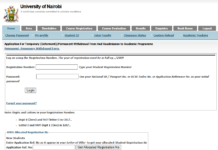
Visit the UON Student Portal at students.uonbi.ac.ke. Click on Apply Now and create an account. Fill in your personal details, academic qualifications, and programme choice. Pay the application fee (currently KSh 1,000 for most programmes).
Step Four: Submit Your Documents
Upload scanned copies of the following:
- KCSE certificate or result slip
- National ID or birth certificate
- Recent passport-size colour photograph
- KCPE certificate
- Any other qualifications (diploma, certificates) if applicable
Step Five: Wait for Your Admission Letter
Once placed, you will receive an admission letter from UON via your registered email or the student portal. Print this letter as it will be required during reporting.
Step Six: Report and Register
Report to your respective UON campus on the indicated date with original academic certificates, your admission letter, and the first-semester fee payment receipt. Complete registration through the student portal and collect your student ID.
Important Tips for Kenyan Students Applying to UON
- Apply early. Both KUCCPS and direct UON applications have strict deadlines. Missing the deadline means waiting for another intake cycle.
- Choose your programme wisely. Do not apply for a course just because it is popular. Research career prospects and ensure it aligns with your strengths and goals.
- Apply for HELB early. The Higher Education Loans Board provides government-sponsored students with financial support for fees and upkeep. Applications open annually, usually around January.
- Watch for supplementary intakes. UON occasionally runs supplementary admissions for self-sponsored applicants. Monitor the official UON website and social media pages for announcements.
- Consider a diploma as a pathway. If your KCSE grades do not meet degree requirements, a diploma from UON or other accredited institutions can lead to degree admission through credit transfer.
- Beware of scams. Only use the official UON website (uonbi.ac.ke) and KUCCPS portal for applications. Do not pay any individual claiming to offer guaranteed admission.
Frequently Asked Questions (FAQs)
What is the minimum grade for admission to the University of Nairobi?
The minimum KCSE grade for admission to UON depends on the course you are applying for. The lowest entry requirement is C+ (Plus) for Arts, Education, and some Social Sciences programmes. Competitive programmes like Medicine require A Plain, while Engineering and Law require B+ (Plus) as the minimum qualifying grade.
Can I apply to UON without going through KUCCPS?
Yes. If you were not placed through KUCCPS or did not meet the government-sponsored cut-off, you can apply directly to UON through the self-sponsored pathway. Visit the UON student portal, fill in the application form, pay the application fee, and submit the required documents. Self-sponsored places are available for most faculties and have a slightly different cut-off structure.
How is the UON admission cut-off point calculated?
UON uses a weighted cluster point system to calculate admission scores. Each degree programme has a cluster of four specific subjects. Your marks in these subjects are assigned different weights (usually 2, 2, 1, 1) and averaged to produce your weighted mean grade. KUCCPS then ranks all applicants by this score and offers places to the highest-scoring students until all available slots are filled.
Does UON accept mature entry applicants?
Yes. The University of Nairobi has a mature entry scheme for applicants who are 25 years or older and do not meet the standard KCSE minimum requirements. Mature applicants are usually required to demonstrate relevant work experience (typically 3–5 years), sit a mature entry examination administered by UON, and provide professional certificates or references where applicable. Check the UON admissions page for specific details per faculty.
When does UON open admissions for the 2026/2027 academic year?
UON typically opens its admissions process between January and March each year, following the release of KCSE results. KUCCPS placements are usually done between February and April. Direct self-sponsored applications run on a rolling basis, with main intakes in September/October. Always check the official UON website (uonbi.ac.ke) or the KUCCPS portal for exact dates, as timelines may vary each year.
Final Thoughts
Understanding the University of Nairobi admission requirements is the first and most important step in your journey to joining Kenya’s premier university. Whether you are aiming for Medicine, Law, Engineering, or the Arts, UON has a programme that suits your strengths — and a pathway to get you there.
Make sure you check both the KUCCPS requirements and UON’s self-sponsored entry criteria for your chosen course. Apply early, gather all your documents, and do not forget to apply for HELB funding if you qualify.
Good luck — the doors of the University of Nairobi are waiting for you.
Read also: