Getting into the University of Nairobi (UON) is a dream for thousands of Kenyan students every year. As Kenya’s oldest, largest, and most prestigious public university, UON attracts applications from Form Four leavers, diploma holders, and working professionals alike. But navigating the UON application process can be confusing, especially if you are unsure whether to apply through KUCCPS or directly via the UON application portal.
This comprehensive guide walks you through everything you need to know about how to apply to the University of Nairobi in 2026 — including admission requirements, step-by-step application instructions, fees, intake dates, and tips to improve your chances of getting admitted.

Overview: What Is the University of Nairobi?
The University of Nairobi was founded in 1956 as the Royal Technical College and became a fully independent university in 1970. Today, it is Kenya’s largest public university, with over 80,000 students enrolled across multiple campuses in Nairobi and beyond.
Campuses
- Main Campus (Nairobi CBD)
- Chiromo Campus
- Lower Kabete Campus
- Upper Kabete Campus
- Kikuyu Campus
- Kenyatta National Hospital Campus
- Parklands Campus
- Kisumu Campus
Programmes Offered
UON offers programmes across all major fields including Medicine, Law, Engineering, Business, Education, Agriculture, Arts, Science and Technology. It is consistently ranked as the Number 1 university in Kenya and among the top universities in Africa.
Two Ways to Apply to UON
Before you start your application, you need to understand which pathway applies to you. There are two main routes to join the University of Nairobi.
A) Government-Sponsored (Module I) — Via KUCCPS
This route is for Form Four leavers who sat the KCSE examination and attained a mean grade of C+ and above. The Kenya Universities and Colleges Central Placement Service (KUCCPS) manages this process. If you qualify, you apply through the KUCCPS student portal and UON receives your placement results directly. Your tuition is government-funded, and you may be eligible for a HELB loan or bursary.
B) Self-Sponsored (Module II) — Via UON Application Portal
This route is for students who did not qualify for government sponsorship, diploma or certificate holders seeking to upgrade, working professionals, and international students. You apply directly through the official UON application portal at application.uonbi.ac.ke and pay the applicable application fee.
UON Admission Requirements
What are the UON admission requirements? For undergraduate admission, you need a KCSE mean grade of C+ (Plus) or equivalent, with specific subject grades depending on your chosen programme. Postgraduate applicants need a relevant bachelor’s degree. Requirements vary by faculty and course.
Undergraduate Requirements
- KCSE mean grade of C+ (Plus) as a minimum
- Specific subject combinations depending on your programme — for example, Health Sciences requires at least a C in Biology and one of Physics, Chemistry, or Mathematics
- Holders of a Certificate or Diploma with a KCSE grade of C- and above may qualify for some programmes
- Higher National Diploma (HND) holders in relevant fields may be considered for direct entry
Postgraduate Requirements
- Masters Degree: A bachelor’s degree with at least Second Class Honours (Upper Division), or Second Class Lower with two years of relevant work experience
- PhD: A relevant master’s degree from a recognised university
- Postgraduate Diploma or Certificate: A pass degree in a relevant field
Note: Admission requirements differ from programme to programme. Always check the specific requirements for your chosen course on the UON website before applying.
How to Apply to UON via KUCCPS (Government-Sponsored Students)
If you sat the KCSE examination and attained a mean grade of C+ and above, follow these steps to apply for a government-sponsored slot at UON through KUCCPS.
Step 1: Visit the KUCCPS Student Portal
Go to students.kuccps.net. Log in using your KCSE index number and year — for example, 12345678901/2025. Your default password is your KCPE index number or birth certificate number unless you previously changed it.
Step 2: Download the Programme List
Before selecting courses, download the list of available degree programmes and cluster documents from the portal. These contain minimum subject requirements and previous cut-off points, which are very useful for making smart course choices.
Step 3: Check Your Cluster Weight
Your cluster weight is displayed on the portal and is calculated from your four best-performing relevant subjects. Compare it to the previous year’s cut-off points for your target programme at UON to assess your chances.
Step 4: Select Your Courses
Navigate to the Application tab and enter the course codes for your preferred programmes at UON. You can select multiple choices, so rank them strategically. Start with your most preferred programme and include safer back-up options.
Step 5: Pay the Application Fee
KUCCPS charges Ksh 1,500 as a placement application fee, payable via M-Pesa through the eCitizen portal. After payment, you will receive an eCitizen Payment Reference Code.
Step 6: Submit Your Application
Enter the eCitizen Payment Reference Code to finalise and submit your application. Log out securely after submitting and keep your application reference safe.
Step 7: Wait for Placement Results
KUCCPS releases placement results typically around May each year. You will receive an SMS notification and can check your placement status on the KUCCPS portal. If placed at UON, proceed to download your admission letter from the UON SMIS portal at smis.uonbi.ac.ke.
How to Apply to UON Online (Self-Sponsored Students)
Self-sponsored students apply directly through the UON application portal. Here is the full step-by-step UON online application process.
Step 1: Visit the Official UON Application Portal
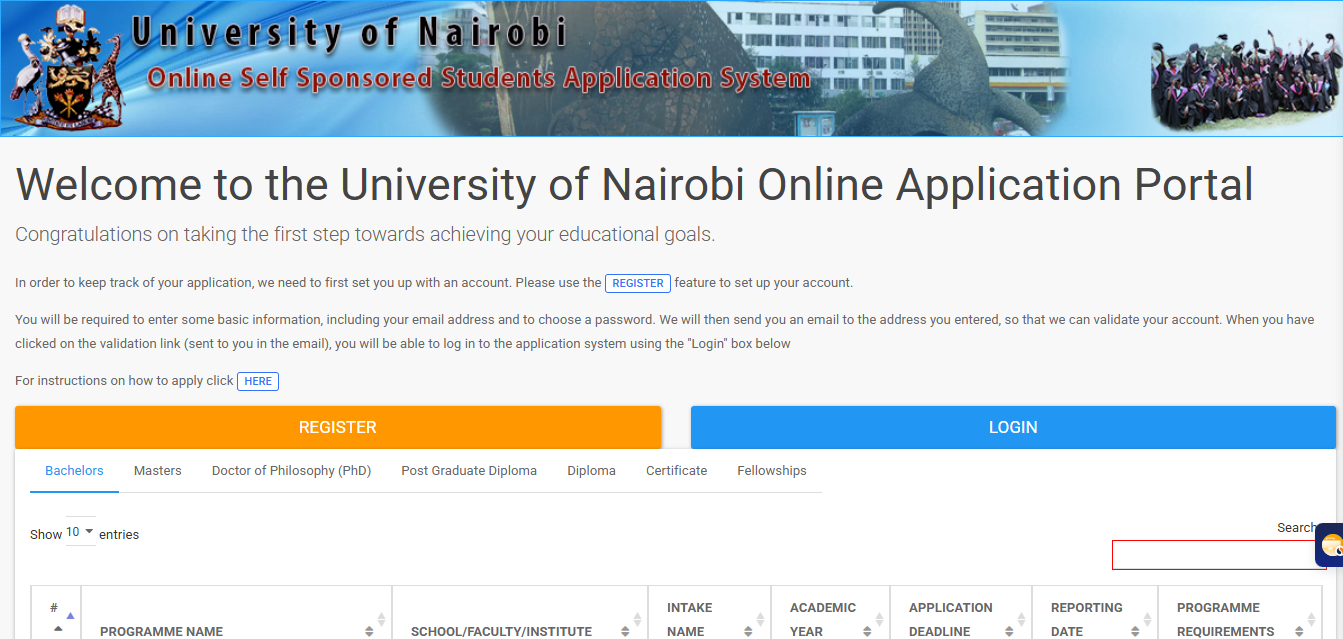
Go to application.uonbi.ac.ke. This is the only official platform for self-sponsored applications. UON does not use agents or third-party representatives, so be cautious of anyone claiming to process applications on your behalf.
Step 2: Create an Account
If you are a first-time user, register with a valid email address, an active phone number, and a postal address. These details will be used for all communications, so make sure they are accurate.
Step 3: Browse Available Programmes
The portal displays all courses available for the current intake, along with open intakes, application deadlines, reporting dates, and specific programme requirements. Confirm that you meet the requirements for your chosen course before proceeding.
Step 4: Fill in the Application Form
Select your programme of choice and complete the online application form. You will be required to upload certified scanned copies of your academic certificates, transcripts, a current passport-size photo, and any other documents specified by the programme.
Step 5: Pay the Application Fee
A non-refundable application fee is required to process your application. Pay using M-Pesa, Visa/Mastercard, or bank transfer. The system will issue you an applicant reference number to use as your account number during payment. You will receive confirmation via email and SMS.
Step 6: Submit Your Application
After payment is confirmed, complete and submit your application. Save your applicant reference number, as you will need it to track your application status and log in to the UON student portal if admitted.
Step 7: Wait for a Letter of Offer
Successful applicants will receive a Letter of Offer (admission letter) by email and can also download it from the SMIS portal at smis.uonbi.ac.ke using their application reference number.
UON Application Fees and Payment Methods
Here is a summary of UON application fees for 2026.
Fee Structure
| Level of Study | Local Students | International Students |
|---|---|---|
| Undergraduate | Ksh 3,000 | USD 50 |
| Masters | Ksh 3,000 | USD 50 |
| PhD | Ksh 4,000 | USD 50 |
Accepted Payment Methods
- M-Pesa (most convenient for local applicants)
- Visa or Mastercard (online payment)
- Bank transfer (for international students)
Important: The application fee is non-refundable, even if you are not offered a place. Always double-check that you meet the programme requirements before paying.
UON Intake Dates and Deadlines 2026
The University of Nairobi admits self-sponsored students three times a year.
2026 Intake Schedule
| Intake | Reporting Month | Application Deadline (Approx.) |
|---|---|---|
| January/February Intake | January | Early December |
| September Intake | August/September | End of July |
| December Intake | December | Mid November |
How to Confirm Deadlines
UON releases specific deadlines for each intake on the application portal. Always visit application.uonbi.ac.ke to confirm the current open intakes and their exact closing dates. Missing a deadline means waiting for the next intake.
What Happens After You Apply?
Once your application is submitted and processed, here is what to expect.
Receiving Your Admission Letter
You will receive a Letter of Offer via email or through the SMIS portal at smis.uonbi.ac.ke. KUCCPS students log in using their registration number and index number. Self-sponsored students use their Application Reference Number.
Accepting Your Offer
Log in to the SMIS portal and confirm your acceptance online. Rejecting the offer — or simply ignoring it — means losing your place. Download your admission letter and joining instructions, which include your reporting date, required documents, fee structure, and orientation details.
Applying for Financial Support
KUCCPS-placed students can apply for a government scholarship or HELB loan via portal.hef.co.ke. Apply as early as possible because bursaries and scholarships are limited and competitive.
Reporting Date
The 2026/2027 academic year for new first years begins in August 2026. Orientation week typically runs for about one week before formal classes begin.
Important Tips for Kenyan Students
Apply Early
Intakes fill up fast, especially for popular programmes like Medicine, Law, and Engineering. Submit your application well before the closing date to avoid last-minute technical issues on the portal.
Use Only the Official Portal
UON does not use agents or third parties. Only apply through application.uonbi.ac.ke. Anyone asking you to pay them to process your UON application is a fraudster.
Double-Check Programme Requirements
Before paying your application fee, confirm that you meet the specific subject requirements for your chosen course. A mean grade of C+ is the general minimum, but many courses require higher grades in specific subjects.
Keep Your Documents Ready
Have certified copies of your KCSE certificate, transcripts, national ID, and a recent passport photo ready before starting your application. Uploading incorrect or uncertified documents can lead to rejection.
Apply for Financial Aid Early
If you are a KUCCPS student, apply for HELB support as soon as you receive your admission letter through portal.hef.co.ke. Bursaries and scholarships are limited and competitive.
Explore All Campuses and Programmes
UON has campuses across Nairobi and in Kisumu. Some programmes may be offered at a campus different from the Main Campus. Confirm the campus before reporting.
Frequently Asked Questions (FAQ)
Q1: What is the minimum grade required to join the University of Nairobi?
The minimum KCSE mean grade for undergraduate admission at the University of Nairobi is C+ (Plus). However, many competitive programmes such as Medicine, Law, and Engineering require much higher grades. Certificate and diploma holders may qualify for some programmes with a C- and above.
Q2: How do I apply to UON as a self-sponsored student?
To apply as a self-sponsored student, visit the official UON application portal at application.uonbi.ac.ke. Create an account, select your programme, fill in the application form, upload the required documents, and pay the non-refundable application fee of Ksh 3,000 (undergraduate and masters) or Ksh 4,000 (PhD).
Q3: Can I apply to UON without going through KUCCPS?
Yes. Students who do not qualify for government sponsorship, or who wish to study as self-sponsored students, can apply directly through the UON online application portal without going through KUCCPS. This includes diploma upgraders, mature-age applicants, and international students.
Q4: When is the UON application portal open in 2026?
The UON application portal is open throughout the year for the January, September, and December intakes. Specific opening and closing dates for each intake are displayed on the portal at application.uonbi.ac.ke. Check regularly for the most up-to-date intake announcements.
Q5: How do I download my UON admission letter?
After receiving your placement or offer, visit the UON SMIS portal at smis.uonbi.ac.ke. KUCCPS students log in using their registration number and KCSE index number as the password. Self-sponsored students use their Application Reference Number. Once logged in, navigate to the admission letter section and download your letter.
Final Thoughts
Knowing how to apply to the University of Nairobi correctly can save you time, money, and frustration. Whether you are a KCSE graduate going through KUCCPS or a self-sponsored student using the UON application portal, following the right steps is key to securing your place at Kenya’s top university.
Always use official channels, prepare your documents in advance, apply early, and check the UON website regularly for updates on intakes, deadlines, and programme changes.
Contact the UON Admissions Office
- Email: admission@uonbi.ac.ke
- Phone: +254-20-318262
- Application Portal: application.uonbi.ac.ke
- Student Portal (SMIS): smis.uonbi.ac.ke
Best of luck with your 2026 application. The University of Nairobi awaits you.
Read also:
- Universities Offering Law Courses in Kenya: Complete 2026 Guide
- University of Nairobi Courses and Fees 2026: The Complete Guide
- Jomo Kenyatta University of Agriculture and Technology Courses and Fees: Complete 2026 Guide
- University of Nairobi Admission Requirements: Everything You Need to Know in 2026