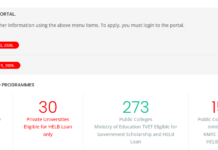

Kenya has 507+ government-linked institutions in the 2026 KUCCPS eligibility framework — including 42 public universities and the Open University of Kenya that qualify for both government scholarships and HELB loans, 272 public TVET colleges under the Ministry of Education eligible for both scholarships and HELB, 153 public colleges under other ministries (including all KMTC campuses) eligible for HELB loans only, and 30 private universities eligible for HELB loans only.
Government sponsorship is delivered through Kenya’s Student-Centred Funding Model (SCFM) — covering 38% to 100% of tuition through scholarships, depending on assessed financial need, with HELB loans and upkeep grants on top. The single access point for government-sponsored placement is kuccps.Net.



What “Government Sponsored” Actually Means in Kenya’s Higher Education System (2026)
The phrase “government sponsored college” is widely used in Kenya but frequently misunderstood. This guide clarifies exactly what government sponsorship means, who qualifies, which institutions are covered, and what financial benefits students can actually access — using the latest 2026 official data.
The Three Pillars of Government Sponsorship
Kenya’s higher education funding system operates through three distinct but interlinked pillars:
Pillar 1 — KUCCPS Placement The Kenya Universities and Colleges Central Placement Service is a State Corporation that provides career guidance and selects students for admission to universities, national polytechnics, technical training institutes and other accredited higher learning institutions for Government of Kenya-sponsored programmes. KUCCPS places students; it does not directly fund them.
Pillar 2 — Universities Fund (UF) Scholarships The Universities Fund was established under Section 53 of the Universities Act 2012. Under the new Student-Centred Funding Model, the UF provides scholarships to KUCCPS-placed students in public universities, covering 38% to 100% of tuition depending on assessed household income.
Pillar 3 — Higher Education Loans Board (HELB) HELB provides loans to cover tuition costs not covered by the UF scholarship, plus upkeep (living costs) loans to eligible students. HELB loans are available to both public and some private institution students, though at different rates and conditions.
The combined system is called the Higher Education Variable Scholarships and Loans Funding Model — informally known as the Student-Centred Funding Model (SCFM). It was unveiled by President William Ruto on May 3, 2023, to address challenges that public universities and TVET institutions were facing, primarily attributed to massive enrolment and inadequate funding.
The Official 2026 KUCCPS Eligibility Framework — Every Category Explained
In January 2026, KUCCPS published the definitive list of institutions eligible for government scholarships and HELB funding. The classification has four tiers:
Tier 1: 42 Public Universities + Open University of Kenya
Eligible for: Government Scholarship + HELB Loan
A total of 42 public universities and the Open University of Kenya qualify for both government scholarships and HELB loans, making public universities and the Open University of Kenya the main beneficiaries of government-backed higher education financing.
These are Kenya’s fully chartered, government-owned universities — the institutions most people think of when they say “government university.” Students placed here by KUCCPS can access UF scholarships (38%–100% of tuition) and HELB upkeep loans simultaneously.
Tier 2: 272 Public TVET Colleges — Ministry of Education
Eligible for: Government Scholarship + HELB Loan
A total of 272 public colleges under the Ministry of Education offering Technical and Vocational Education and Training (TVET) programmes are eligible for both government scholarships and HELB loans. This tier covers all national polytechnics, technical training institutes, teacher training colleges, and other Ministry of Education TVET institutions.
For TVET students, the government pays KES 30,000 per year in capitation directly to the institution, and HELB provides additional loan support.
Tier 3: 153 Public Colleges Under Other Ministries (Including KMTC)
Eligible for: HELB Loan Only (No Scholarship)
A further 153 public colleges operating under other government ministries and the Kenya Medical Training Colleges (KMTC) have been approved for HELB loans only. This is a critical distinction — KMTC students, despite attending a government college, do not receive UF scholarships. They pay the full KMTC fee structure (KES 82,200 Year 1; KES 78,000 Years 2–3) but can access HELB loans to offset costs.
Tier 4: 30 Private Universities
Eligible for: HELB Loan Only (No Scholarship)
A total of 30 private universities have been listed as eligible for HELB loans only, meaning students admitted to these institutions will not receive government scholarships. Students at private universities pay market-rate fees but can access HELB loans to partially finance their studies.
Tier 5: 35 University-Level TVET Institutions
Eligible for: Neither Scholarship nor HELB
KUCCPS revealed that 35 university-level TVET institutions had also been included in the eligibility list, but with no qualification for either government scholarship or HELB loans. Students at these institutions must self-fund entirely.
Summary Table
| Institution Category | Count | Scholarship | HELB Loan |
|---|---|---|---|
| Public Universities | 42 + Open University | ✅ Yes | ✅ Yes |
| Public TVET (MoE) | 272 | ✅ Yes | ✅ Yes |
| Public Colleges (Other Ministries + KMTC) | 153 | ❌ No | ✅ Yes |
| Private Universities | 30 | ❌ No | ✅ Yes |
| University-Level TVET | 35 | ❌ No | ❌ No |
How the Student-Centred Funding Model (SCFM) Works in 2026
The SCFM replaced the old Differentiated Unit Cost (DUC) model that previously funded universities. Under the new system, universities and TVET institutions no longer receive block funding in the form of capitation. Instead, funding to students is provided through scholarships, loans, and household contributions.
The Means Testing Instrument (MTI)
The cornerstone of the SCFM is the Means Testing Instrument (MTI) — a scientifically designed tool used to assess each student’s level of financial need using proxy indicators of household income, assets, and vulnerability. Your MTI score determines which funding band you fall into and therefore how much scholarship and loan support you receive.
Students interested in receiving scholarships must formally apply through the Higher Education Financing (HEF) portal at hef.co.ke.
The Five Funding Bands
The SCFM divides students into five bands based on assessed monthly household income:
| Band | Monthly Household Income | Scholarship % | Loan % | Household Contribution % | Upkeep Loan (KES) |
|---|---|---|---|---|---|
| Band 1 (Vulnerable) | Below KES 5,995 | 70% | 25% | 5% | 60,000 |
| Band 2 (Very Needy) | KES 5,995–23,670 | 60% | 30% | 10% | 55,000 |
| Band 3 (Needy) | KES 23,670–70,000 | 50% | 30% | 20% | Varies |
| Band 4 (Less Needy) | KES 70,000+ (lower) | 38% | 55% | 7% | Varies |
| Band 5 (Least Needy) | KES 70,000+ (higher) | 38% | 55% | 7% | Varies |
For the most vulnerable students (Band 1), the government scholarship covers 70% of fees while the loan covers 25%, making the total support 95%. The family pays just 5% and the student receives an upkeep loan of KES 60,000.
The neediest student category is supposed to receive 100% government scholarship as the least needy category gets allocated a higher share of loans (55%) with less in government scholarship (38%) and 7% to be met through household contribution.
What the Numbers Mean in Practice
Example: Engineering student at University of Nairobi (Band 1 — most vulnerable)
- Full programme cost: Approximately KES 300,000/year
- Government scholarship (70%): KES 210,000
- HELB tuition loan (25%): KES 75,000
- Family contribution (5%): KES 15,000
- HELB upkeep loan: KES 60,000
Example: Business student at Kenyatta University (Band 3 — needy)
- Full programme cost: Approximately KES 120,000/year
- Government scholarship (50%): KES 60,000
- HELB tuition loan (30%): KES 36,000
- Family contribution (20%): KES 24,000
- HELB upkeep loan: KES 55,000
Example: Diploma student at Eldoret National Polytechnic (TVET — KES 56,420/year)
- Government capitation: KES 30,000
- Student pays net: KES 26,420
- HELB TVET loan: Up to KES 60,000 (fully covers the student’s portion and contributes to living costs)
The Funding Gap Problem (2026)
The SCFM faces a serious structural challenge in 2026 that every student and parent should be aware of. While the resource requirement for scholarships in 2026/27 stands at KES 47.36 billion, the approved allocation is KES 17.92 billion — just 37.8 per cent of the requirement — leaving an annual shortfall of KES 29.44 billion and pushing the cumulative deficit to KES 51.7 billion.
New student enrolment is projected to grow from 122,634 in the previous year to 219,279 this year, with cumulative students on scholarship expected to hit 656,927. However, allocations have not kept pace with the expansion.
Practical implication for students: Apply for the HEF scholarship as early as possible and do not assume you will receive the maximum band entitlement. Also apply independently for HELB loans, county bursaries, and NG-CDF bursaries to build multiple layers of financial support.
Complete List of 42 Public Universities in Kenya (Government Sponsored, 2026)
These are Kenya’s CUE-accredited public universities eligible for both government scholarships and HELB loans under the SCFM. The Commission for University Education (CUE) released its January 2026 list of all 83 institutions approved to offer degree programmes in Kenya, with 42 being public universities eligible for full government funding.
Public Universities — Nairobi Region
| University | Location | Notable Strengths |
|---|---|---|
| University of Nairobi (UoN) | Nairobi CBD and multiple campuses | Medicine, Law, Engineering, Sciences — Kenya’s oldest and largest public university |
| Kenyatta University (KU) | Kahawa, Nairobi | Education, Business, Science, Humanities — largest by enrolment nationally |
| Technical University of Kenya (TUK) | Haile Selassie Ave, Nairobi | Technical/applied sciences, engineering, computing — Kenya’s premier technical university |
| Multimedia University of Kenya (MMU) | Mbagathi Road, Nairobi | ICT, media, engineering — specialised in digital and communications technology |
| Co-operative University of Kenya (CUK) | Karen, Nairobi | Cooperative management, business, social sciences |
| Kenya Coast University of Science and Technology | Kilifi (Coast-based main) | Sciences, technology — newer university serving the Coast region |
Public Universities — Central Kenya and Mount Kenya Region
| University | Location | Notable Strengths |
|---|---|---|
| Jomo Kenyatta University of Agriculture and Technology (JKUAT) | Juja, Kiambu | Engineering, Agriculture, Computing, Business — second largest by enrolment |
| Dedan Kimathi University of Technology | Nyeri | Technology, Engineering, Business |
| Karatina University | Karatina, Nyeri | Agriculture, Business, Education, Social Sciences |
| University of Embu | Embu | Agriculture, Environment, Sciences, Business |
| Kirinyaga University | Kerugoya, Kirinyaga | Agriculture, Technology, Business |
Public Universities — Rift Valley
| University | Location | Notable Strengths |
|---|---|---|
| Moi University | Kesses, Eldoret (main) + branches | Medicine, Engineering, Law, Sciences — Kenya’s third-oldest university |
| University of Eldoret (UoE) | Eldoret | Agriculture, Engineering, Sciences, Education |
| Egerton University | Nakuru (main) | Agriculture, Education, Environmental Sciences, Humanities |
| University of Kabianga | Kericho | Agriculture, Business, Education |
| Kisii University | Kisii | Business, Education, Sciences |
| Maasai Mara University | Narok | Sciences, Education, Business |
| Rongo University | Rongo, Migori | Business, Education, Sciences |
Public Universities — Western Kenya
| University | Location | Notable Strengths |
|---|---|---|
| Masinde Muliro University of Science and Technology | Kakamega | Engineering, Sciences, Technology, Education |
| Maseno University | Maseno, Kisumu | Sciences, Business, Education, Health |
| Jaramogi Oginga Odinga University of Science and Technology (JOOUST) | Bondo, Siaya | Sciences, Technology, Engineering |
| University of Rongo | Rongo | Education, Agriculture, Business |
| Alupe University | Busia | Sciences, Technology — recently chartered |
Public Universities — Eastern Kenya
| University | Location | Notable Strengths |
|---|---|---|
| Chuka University | Chuka, Tharaka-Nithi | Agriculture, Sciences, Business, Education |
| Tharaka University | Tharaka-Nithi | Education, Sciences, Business — recently chartered |
| South Eastern Kenya University (SEKU) | Kitui | Engineering, Agriculture, Sciences |
Public Universities — Northern and Northeastern Kenya
| University | Location | Notable Strengths |
|---|---|---|
| Garissa University | Garissa | Sciences, Education, Business — serves the NFD region |
| University of Lamu | Lamu | Sciences, Social Sciences — coastal and maritime focus |
Public Universities — Coast and South Kenya
| University | Location | Notable Strengths |
|---|---|---|
| Technical University of Mombasa (TUM) | Mombasa | Engineering, Maritime, Business, ICT |
| Pwani University | Kilifi | Sciences, Agriculture, Business, Education |
| Taita Taveta University | Voi | Mining, Engineering, Sciences, Education |
Specialised Public Universities
| University | Location | Notable Strengths |
|---|---|---|
| Kenya Methodist University (KEMU) | Meru | Business, Education, Sciences (faith-based public) |
| Open University of Kenya | Online/distributed | Distance learning across all disciplines |
| Kibabii University | Bungoma | Sciences, Education, Business |
| Murang’a University of Technology | Murang’a | Technology, Agriculture, Business |
| Laikipia University | Nyahururu, Laikipia | Education, Sciences, Agriculture |
| Machakos University | Machakos | Engineering, Sciences, Business |
| Koitalel Samoei University College | Nandi | Sciences, Education — constituent college of Moi University |
| University of Eastern Africa, Baraton | Nandi Hills | Sciences, Nursing, Business (Seventh-day Adventist but public-chartered) |
| African Nazarene University | Rongai, Kajiado | Education, Business, Theology |
| Scott Christian University | Machakos | Education, Business, Community Development |
| Adventist University of Africa | Mbagathi, Nairobi | Theology, Business, Public Health |
The 272 Public TVET Colleges Eligible for Full Government Funding
The 272 public TVET colleges under the Ministry of Education are the heart of Kenya’s practical skills training system — and they are also the most financially accessible pathway for students from lower-income households, as they receive both government capitation and HELB loan eligibility.
These 272 institutions fall into four operational categories:
National Polytechnics (30 Institutions)
Kenya’s 30 National Polytechnics are the flagship TVET colleges, offering the broadest range of programmes at the highest quality level. Every national polytechnic is eligible for government sponsorship and HELB. Key examples:
| Region | National Polytechnic |
|---|---|
| Nairobi | Nairobi National Polytechnic, Technical University of Kenya (also a university), Kabete National Polytechnic |
| Rift Valley | Eldoret National Polytechnic (Kenya’s #1 ranked), Rift Valley National Polytechnic (Nakuru) |
| Western | Sigalagala National Polytechnic (Kakamega), Kisumu National Polytechnic |
| Nyanza | Kisii National Polytechnic |
| Coast | Kenya Coast National Polytechnic (Mombasa) |
| Eastern | Meru National Polytechnic |
| North Rift | Kitale Technical Training Institute |
| Central | Nyandarua National Polytechnic, Murang’a National Polytechnic |
All 30 national polytechnics: KUCCPS fee structure = KES 56,420/year total (student pays KES 26,420 after government capitation of KES 30,000).
Technical Training Institutes (TTIs)
Kenya has several dozen public Technical Training Institutes — mid-tier TVET colleges offering certificate and diploma programmes. Examples include C. Kinyanjui TTI (Nairobi), Thika Technical Training Institute (Kiambu), and Ruiru TTI (Kiambu). All public TTIs under the Ministry of Education are KUCCPS-listed and eligible for both scholarship and HELB.
Teacher Training Colleges (TTCs) — 34 Public Institutions
All 34 government public TTCs are eligible for government sponsorship. Annual fee: KES 67,189 (Ministry of Education-guided), with government contribution embedded in the fee structure. Key public TTCs include Kagumo, Kamwenja, Shanzu, Eregi, Asumbi, Mosoriot, Machakos, Narok, and Garissa.
Technical and Vocational Colleges (TVCs)
County-level TVET colleges operating under the Ministry of Education are also included in the 272 eligible institutions. These serve the broadest geographic reach at the most affordable fees.
KMTC and Other Ministry Colleges — HELB Only (153 Institutions)
The 153 public colleges under other government ministries — most prominently Kenya Medical Training College (KMTC) under the Ministry of Health — are eligible for HELB loans but not UF scholarships.
KMTC (98 Campuses)
KMTC is the most significant institution in this category. With 98 campuses in 45 of 47 counties and over 21,000 intake slots per cycle, KMTC trains more healthcare professionals than any other institution in Kenya.
KMTC students do not receive UF scholarships but can access HELB TVET loans. Fee structure: KES 82,200 in Year 1, KES 78,000 in Years 2 and 3 (total KES 238,200 for a 3-year diploma). All payments through Jiunge Platform, Paybill 222222.
Other Ministry Colleges in This Category
- Kenya School of Government (KSG) — Ministry of Public Service
- Kenya Forest Service Training College — Ministry of Environment
- Kenya Wildlife Service Training Institute — Ministry of Tourism
- National Youth Service (NYS) training centres — Ministry of Defence
- Kenya Police College / Prisons Staff Training College — Ministry of Interior (limited public access)
- Agriculture training institutes — Ministry of Agriculture
How to Access Government Sponsorship in Kenya — Step-by-Step (2026)
Step 1: Qualify Through KCSE
The minimum KCSE grades for government-sponsored placement are:
- Degree programmes: C+ (Plus) and above
- Diploma programmes: C- (Minus) and above
- Craft Certificate programmes: D (Plain) and above
- Artisan Certificate programmes: D- (Minus) and above (E grade acceptable at some institutions)
All KCSE certificate holders who have not previously benefited from government sponsorship are eligible to apply regardless of which year they sat the examination.
Step 2: Apply Through KUCCPS
- Log into students.kuccps.net using your KCSE index number and password.
- Browse available programmes at government-sponsored institutions.
- Select up to six course-institution combinations, ranked in order of preference.
- Verify that each institution and programme is listed for government-sponsored placement (look for the “Gov. Sponsored” tag in the portal).
- Pay the KES 1,500 application fee online.
- Submit before the published deadline.
- Await placement notification via SMS and the portal.
Step 3: Apply for HEF Scholarship
Immediately after receiving your KUCCPS placement letter:
- Visit hef.co.ke and create an account.
- Complete the online application for the Higher Education Financing scholarship.
- Fill in the Means Testing Instrument (MTI) questionnaire — you will be asked about your family’s household income, assets, number of dependants, and social vulnerability indicators.
- Attach required supporting documents (family income evidence, disability certificates if applicable, death certificates for orphans, etc.).
- Submit your application and note your MTI score.
- You will be assigned to a funding band (1–5) based on your MTI assessment.
- Scholarship disbursements are processed at the beginning of each semester to your institution and your HELB account.
Step 4: Apply for HELB Loan
Simultaneously with your HEF application:
- Visit helb.co.ke and create a student account.
- Select your institution and programme.
- Apply for the HELB tuition and upkeep loan.
- Submit required documents: admission letter, national ID, guarantor information, bank account details.
- HELB upkeep loans for 2025/2026 have been disbursed — KSh 156 billion in upkeep funds for continuing students was released in January 2026. For new students, apply immediately after admission.
Step 5: Supplement with County and NG-CDF Bursaries
Even with HEF scholarships and HELB loans, the gap between what the government provides and the actual cost of attending university remains. Fill the gap by applying simultaneously for:
- County Government Bursary: Contact your county government’s education bursary office — most counties have an annual bursary allocation.
- NG-CDF (National Government Constituencies Development Fund) Bursary: Apply at your local NG-CDF office — every constituency has an education bursary fund.
- Religious / church bursaries: Many denominations run education bursary programmes for members.
- NGO and corporate scholarships: Several organisations including Equity Bank (Wings to Fly), Kenya Airways Foundation, KCB Foundation, and others offer competitive scholarships alongside government funding.
What Government Sponsorship Does NOT Cover — Important Caveats
Understanding what government sponsorship does not include prevents expensive surprises:
| Item | Covered? | Notes |
|---|---|---|
| Tuition fees (public university) | Partially (38%–100% via scholarship + loan) | Depends on MTI band |
| Tuition fees (TVET under MoE) | KES 30,000 capitation + HELB | Student pays residual (e.g., KES 26,420 at polytechnics) |
| Upkeep / living expenses | Partially (HELB upkeep loan KES 55,000–60,000/year) | Does not cover full living costs |
| Accommodation on campus | Not directly | Some institutions have subsidised hostels |
| Textbooks and materials | Not directly | Students purchase independently |
| Examination fees | Usually included in fees | Confirm with institution |
| KMTC tuition | HELB only (no scholarship) | Student pays full fee minus HELB |
| Private university tuition | HELB only (no scholarship) | No UF scholarship for private institutions |
| Self-sponsored / Module II | HELB only | No scholarship |
| Transfer to different course | May lose sponsorship | Consult KUCCPS before transferring |
Private Universities Eligible for HELB (But Not Scholarship)
These 30 CUE-accredited private universities allow students to access HELB tuition loans despite not qualifying for government UF scholarships. Students pay higher market-rate fees but can borrow from HELB to partially offset costs:
Notable HELB-eligible private universities include:
| University | Location | Strengths |
|---|---|---|
| Mount Kenya University (MKU) | Thika (main) + 15 campuses | Business, Health Sciences, Education, IT |
| Strathmore University | Madaraka, Nairobi | Business, IT, Law — highly selective |
| United States International University Africa (USIU-A) | Kasarani, Nairobi | Business, Sciences, International Relations |
| Aga Khan University (AKU) | Parklands, Nairobi | Medicine, Nursing, Education — premium institution |
| Catholic University of Eastern Africa (CUEA) | Lang’ata, Nairobi | Arts, Sciences, Business, Law |
| Africa International University | Karen, Nairobi | Theology, Education, Business |
| Pan Africa Christian University (PAC) | Embakasi, Nairobi | Business, Education, Social Sciences |
| Daystar University | Athi River, Machakos | Media, Business, Social Sciences, Education |
| Africa Nazarene University | Rongai, Kajiado | Education, Business, Theology |
| Kenya Methodist University (KEMU) | Meru | Business, Education, Sciences |
| Presbyterian University of East Africa (PUEA) | Kikuyu, Kiambu | Education, Business, Theology |
| St. Paul’s University | Limuru, Kiambu | Education, Business, Theology |
| KCA University | Ruaraka, Nairobi | Business, ICT, Accounting |
| Management University of Africa (MUA) | Nairobi | Business, Management |
| Kabarak University | Nakuru | Education, Business, Law, Sciences |
| Great Lakes University of Kisumu | Kisumu | Sciences, Business, Health |
| Riara University | Nairobi | Business, Law, Social Sciences |
| Zetech University | Ruiru / Nairobi | ICT, Business, Engineering |
For the complete list of all 30 HELB-eligible private universities, visit kuccps.net → Registered Members, or helb.co.ke.
Pros and Cons of Government Sponsored Colleges in Kenya
| Pros | Cons | |
|---|---|---|
| Cost | Tuition partially or mostly covered by government scholarship | Funding gap means household contribution still required |
| HELB access | Full HELB tuition and upkeep loans available | HELB repayment begins after graduation — a long-term obligation |
| Quality control | CUE/TVETA regulated — degree/diploma is legally recognised | Some public universities have infrastructure and staffing challenges |
| Prestige | Public university degrees recognised by all employers in Kenya and most internationally | Not all public universities are equal — quality varies by institution |
| Placement fairness | KUCCPS placement is merit-based — transparent and competitive | High-demand courses at top universities are competitive |
| TVET affordability | KES 26,420 net per year at polytechnics is among the most affordable professional training globally | KMTC and ministry college students get HELB only — no scholarship |
| Funding model uncertainty | SCFM is designed to be equitable | Current KES 29.44 billion annual scholarship shortfall creates disbursement uncertainty |
| County and NG-CDF supplements | Multiple additional bursary sources available | Application processes are manual and competitive |
How to Verify If a College Is Government Sponsored
To confirm whether a specific institution or programme qualifies for government sponsorship and/or HELB in 2026:
- KUCCPS portal: Visit students.kuccps.net → Registered Members. Institutions listed as “Public Universities” or “Public TVET under MoE” qualify for scholarships and HELB. “KMTC and other ministry colleges” qualify for HELB only.
- HEF portal: Visit hef.co.ke → check if your institution appears in the scholarship-eligible list.
- HELB portal: Visit helb.co.ke → check the list of HELB-approved institutions for loan eligibility.
- CUE verification (for universities): Visit cue.or.ke to confirm a university is CUE-accredited.
- TVETA verification (for TVET colleges): Visit tveta.go.ke to confirm institutional TVETA registration.
Frequently Asked Questions
1. What are government sponsored colleges in Kenya?
Government sponsored colleges in Kenya are institutions where KUCCPS-placed students receive financial support from the government through the Student-Centred Funding Model. A total of 42 public universities and the Open University of Kenya qualify for both government scholarships and HELB loans, while 272 public TVET colleges under the Ministry of Education are also eligible for both. An additional 153 public colleges under other ministries including KMTC are eligible for HELB loans only, and 30 private universities qualify for HELB loans only. The full list is published at students.kuccps.net.
2. How does government sponsorship work in Kenya in 2026?
Government sponsorship operates through the Student-Centred Funding Model (SCFM), which replaced the old Differentiated Unit Cost model in 2023. Under this model, students placed in public universities by KUCCPS are eligible for both government scholarships from the Universities Fund and HELB loans. Scholarships cover 38%–100% of tuition depending on assessed household income via the Means Testing Instrument (MTI). Students apply for scholarships at hef.co.ke and for HELB loans at helb.co.ke.
3. How do I apply for government sponsorship in Kenya?
Apply through KUCCPS at students.kuccps.net after receiving your KCSE results. The minimum grade for degree programmes is C+ (Plus); for diploma courses it is C- (Minus); for craft certificate it is D (Plain); and for artisan courses it is D- (Minus). After receiving your KUCCPS placement letter, immediately apply for your HEF scholarship at hef.co.ke and your HELB loan at helb.co.ke. Simultaneously apply for county government and NG-CDF bursaries to supplement government funding.
4. Is KMTC government sponsored?
KMTC campuses fall under Tier 3 of the KUCCPS eligibility framework — public colleges under other ministries — making them eligible for HELB loans only, not for government UF scholarships. KMTC students pay the full fee structure (KES 82,200 Year 1; KES 78,000 Years 2–3) but can access HELB TVET loans to offset costs. All payments are made through the Jiunge Platform, Paybill 222222.
5. Can private university students get government sponsorship?
Private university students cannot receive government UF scholarships — scholarships are limited to students placed at public universities by KUCCPS. However, 30 private universities are listed as eligible for HELB loans, allowing students to borrow from HELB to partially fund their private university education. To identify which private universities are HELB-eligible, check the KUCCPS Registered Members page at kuccps.net.
6. How much does the government pay for a student in Kenya 2026?
Under the SCFM, the government covers between 38% and 100% of tuition through the Universities Fund scholarship, depending on assessed household need. For the most vulnerable students (Band 1 — household income below KES 5,995/month), the scholarship covers 70% of fees and the loan covers 25%, with a family contribution of just 5%, plus an upkeep loan of KES 60,000. For TVET students at national polytechnics, the government pays KES 30,000 per year directly to the institution, with the student paying the residual KES 26,420. The total HELB upkeep disbursement for 2025/2026 was KES 156 billion, released in January 2026.
7. What is the difference between KUCCPS placement and HELB?
KUCCPS places students into government-sponsored programmes at universities and colleges — it is the academic admission authority. HELB provides financial loans for tuition and upkeep to eligible students at both public and approved private institutions — it is the lending body. The Universities Fund (UF) provides the scholarship component. These three bodies work together under the Higher Education Financing (HEF) framework at hef.co.ke. KUCCPS places you; UF gives you a scholarship; HELB lends you additional money; you repay HELB after graduation.
8. What happens if I transfer to a different course after KUCCPS placement?
This is a critical risk many students overlook. For university applicants, if you transfer to a different course from the one allocated by KUCCPS, you may be required to pay the same amount of fees paid by privately sponsored students — meaning you lose your government scholarship and are reclassified as a self-sponsored student. Before making any course transfer, consult your institution’s KUCCPS liaison office and confirm the financial implications. Transfers within the same institution and programme cluster carry lower risk than cross-institution transfers.
Final Verdict
Government-sponsored higher education in Kenya is more accessible, more financially supported, and more structurally transparent in 2026 than at any point in the country’s educational history. The Student-Centred Funding Model’s combination of needs-based scholarships, HELB tuition loans, and upkeep grants means that a student from a household earning below KES 6,000 per month can access a public university degree or TVET diploma with a household contribution as low as 5% of fees.
The critical actions for maximising your government sponsorship are: apply through KUCCPS as soon as the window opens; file your HEF scholarship application immediately after placement; apply for HELB simultaneously; stack county and NG-CDF bursaries on top; and never transfer courses without verifying the financial implications first.
The system has gaps — the KES 29.44 billion annual scholarship shortfall is real, and disbursement delays have affected students in previous years. But it remains Kenya’s most powerful tool for expanding access to higher education, and for students who engage with it proactively and correctly, it dramatically reduces the cost of professional qualification.
Read also: