

 TIMEBUCKS
Low minimum
payout of just
$3 — start
earning today!
KUCCPS (Kenya Universities and Colleges Central Placement Service) is the government body responsible for placing KCSE graduates into public universities and colleges in Kenya. Beyond universities, KUCCPS also places students into government-sponsored diploma and certificate programmes at accredited public colleges. These placements are subsidised by the government, making them significantly more affordable than self-sponsored options. Understanding how the KUCCPS college placement process works can open doors that many students do not know exist.
What is KUCCPS and How Does It Work?
The Kenya Universities and Colleges Central Placement Service is a state corporation established under the Universities Act of 2012. Its primary mandate is to coordinate the placement of KCSE candidates into government-sponsored programmes at public universities, colleges, and TVET institutions across Kenya.



Most students associate KUCCPS exclusively with university placement. This is a significant misconception. KUCCPS also manages placement into diploma and certificate programmes at public colleges and TVET institutions — programmes that are government-sponsored, meaning the state subsidises a portion of the tuition fees, making them considerably more affordable for students and their families.
The placement process is centrally managed, transparent, and merit-based. Students apply through the KUCCPS online portal, make course choices in order of preference, and are placed based on their KCSE performance, available slots, and programme-specific cutoff points.
Read also: Teaching Colleges in Kenya 2026: Full Guide to TTCs, Courses, Fees, and TSC Employment
TIMEBUCKS
Low minimum
payout of just
$3 — start
earning today!
KUCCPS College Placement vs University Placement: Key Differences
Understanding the distinction between university and college placement through KUCCPS is essential before you begin your application:

| Factor | University Placement | College / TVET Placement |
|---|---|---|
| Qualification Offered | Degree (3 – 4 years) | Diploma or Certificate (1 – 3 years) |
| Minimum KCSE Grade | C+ (plain) for most programmes | C- to C (plain) for most programmes |
| Government Subsidy | Yes — significantly subsidised | Yes — heavily subsidised |
| Duration | 3 – 4 years | 1 – 3 years |
| Programme Focus | Academic and theoretical | Practical and industry-focused |
| Progression | Can proceed to Masters | Can upgrade to degree via bridging |
| Competition for Places | High | Moderate — less competitive than university |
| HELB Eligibility | Yes | Yes — for accredited institutions |
For students who score below C+ in KCSE, KUCCPS college placement is not a consolation — it is a genuine, government-backed pathway into accredited professional training that leads to real careers.
How the KUCCPS College Application Process Works
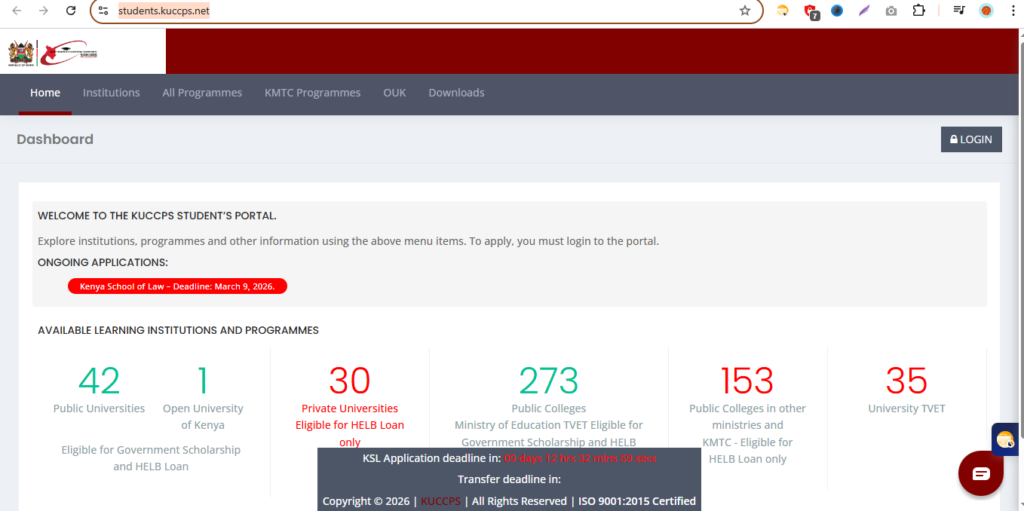
Step 1: Access the KUCCPS Portal
The KUCCPS student portal is accessible at kuccps.net. You will need your KCSE index number and the password provided by your school or the Kenya National Examinations Council (KNEC) to log in for the first time.
Step 2: Understand Your Cluster Points
KUCCPS uses a cluster point system to determine eligibility for specific programmes. Cluster points are calculated from four specific subjects relevant to your chosen course. Before making your choices, calculate your cluster points for the programmes you are interested in — the KUCCPS portal provides a cluster point calculator.
Step 3: Make Your Programme Choices
KUCCPS allows students to select multiple programme choices in order of preference. For college placement, you can select both university and college programmes in your application. It is strongly advisable to include college and TVET programme choices alongside university choices — this increases your chances of securing a government-sponsored placement even if university competition is high.
Step 4: Submit Before the Deadline
KUCCPS application windows open shortly after KCSE results are released. Deadlines are strictly enforced. Missing the application window means waiting for the revision window or the next cycle entirely.
Step 5: Revision Window
KUCCPS opens a revision window after initial placements are made. This allows students who were not placed in their preferred programmes — or who want to change their choices — to revise their applications. The revision window is critically important and should not be ignored.
Step 6: Check Your Placement
Placement results are published on the KUCCPS portal. Students can log in to check which programme and institution they have been placed in. Placement letters are downloadable directly from the portal.
Step 7: Report to Your Institution
Once placed, students must report to their allocated institution by the stated deadline, complete registration, and begin the admission process. Failure to report by the deadline may result in your slot being reallocated.
Government Sponsored Colleges Under KUCCPS in Kenya
The following categories of public colleges receive KUCCPS-placed, government-sponsored students:
Medical Training Colleges
Kenya Medical Training College (KMTC) campuses across all 47 counties are among the most sought-after KUCCPS college placements. Government-sponsored KMTC students pay significantly reduced fees compared to self-sponsored students.
Key KMTC programmes available through KUCCPS:
- Diploma in Clinical Medicine and Surgery
- Diploma in Nursing
- Diploma in Pharmaceutical Technology
- Diploma in Medical Laboratory Sciences
- Diploma in Nutrition and Dietetics
- Diploma in Health Records and Information Management
- Diploma in Orthopaedic Technology
- Diploma in Occupational Therapy
Minimum entry grade: C (plain) for most diploma programmes
Government-sponsored fees: Approximately KSh 15,000 – KSh 30,000 per year for sponsored students (significantly lower than self-sponsored rates)
National Polytechnics and Technical Training Institutes
Kenya’s national polytechnics and technical training institutes receive KUCCPS placements for diploma and higher diploma programmes in engineering, ICT, business, and applied sciences.
Key institutions receiving KUCCPS college placements:
Kenya Polytechnic University College (now Technical University of Kenya) — engineering, ICT, business, applied sciences
Mombasa Technical Training Institute (MTTI) — engineering technology, ICT, hospitality, building and construction
Nairobi Technical Training Institute (NTTI) — electrical, mechanical, civil, ICT, business
Kisumu National Polytechnic (KNP) — engineering, business, ICT, food technology
Eldoret National Polytechnic — engineering technology, ICT, business, agriculture
Meru National Polytechnic — engineering, ICT, business, hospitality
Popular programmes through KUCCPS at national polytechnics:
- Diploma in Electrical and Electronic Engineering
- Diploma in Mechanical Engineering
- Diploma in Civil Engineering
- Diploma in ICT
- Diploma in Business Management
- Diploma in Building and Construction
- Diploma in Food Technology
Minimum entry grade: C- for most diploma programmes; D+ for certificate
Government-sponsored fees: KSh 15,000 – KSh 40,000 per year depending on programme
Kenya Institute of Management (KIM) – Sponsored Programmes
KIM receives a limited number of KUCCPS-sponsored students for its diploma programmes in business management and related fields. Government-sponsored students at KIM benefit from significantly reduced fees compared to self-sponsored rates.
Programmes: Business management, human resource management, procurement, marketing
Minimum entry grade: C- and above
Government-sponsored fees: Reduced from standard rates
Utalii College – Sponsored Placements
Kenya Utalii College receives KUCCPS placements for its hospitality and tourism diploma programmes. Government-sponsored places at Utalii are highly competitive given the college’s strong reputation and limited capacity.
Programmes: Food and beverage production, food and beverage service, housekeeping, front office, tour operations
Minimum entry grade: C (plain)
Government-sponsored fees: Significantly reduced for sponsored students
Kenya School of Government (KSG)
KSG offers government-sponsored professional development and public administration programmes. It primarily serves civil servants and government employees but some programmes are accessible to KUCCPS-placed students targeting public sector careers.
Programmes: Public administration, leadership and governance, policy development
Entry: Selected through government channels and KUCCPS for specific programmes
Specialised Government Colleges
Several specialised government colleges receive KUCCPS placements for niche professional programmes:
Kenya Forestry College (Londiani) — Diploma in Forest Management, Wildlife Management, Environmental Studies
Kenya Water Institute (KEWI) — Diploma in Water Technology, Environmental Management, Water Supply Engineering
Kenya Institute of Highways and Building Technology (KIHBT) — Diploma in Highway Engineering, Building Technology, Quantity Surveying
Kenya Aviation Training Institute (KATI) — Aviation-related certificate and diploma programmes
KUCCPS Cluster Points: How They Are Calculated
KUCCPS uses subject cluster points rather than the raw KCSE mean grade to determine eligibility for specific programmes. This means your overall mean grade does not tell the whole story — what matters is your performance in the four subjects most relevant to your chosen course.
How Cluster Points Work
Each programme at each institution has a defined subject cluster — four specific subjects whose grades are used to calculate your eligibility points. The formula converts your grades in those four subjects into a cluster point score out of 84.
Grade to point conversion:
| KCSE Grade | Points Awarded |
|---|---|
| A (Plain) | 12 |
| A- | 11 |
| B+ | 10 |
| B (Plain) | 9 |
| B- | 8 |
| C+ | 7 |
| C (Plain) | 6 |
| C- | 5 |
| D+ | 4 |
| D (Plain) | 3 |
| D- | 2 |
| E | 1 |
Your cluster points are the sum of points from your four cluster subjects, giving a maximum of 48 points. The KUCCPS portal multiplies this by a weighting factor to produce the final cluster score out of 84.
Common Subject Clusters for College Programmes
| Programme | Typical Cluster Subjects |
|---|---|
| Clinical Medicine | Biology, Chemistry, Physics or Maths, English |
| Nursing | Biology, Chemistry, English, any Group 3 subject |
| Electrical Engineering | Maths, Physics, English, any Group 4 subject |
| Business Management | Maths, English, any two Group 2 or 3 subjects |
| ICT / Computer Science | Maths, Physics, English, any Group 4 subject |
| Food Technology | Biology, Chemistry, Home Science, English |
| Hospitality / Tourism | English, any Group 2, Geography or History, any Group 4 |
Always use the KUCCPS portal’s official cluster calculator to determine your exact cluster points for each programme you are considering. Do not rely on third-party calculators or unofficial estimates.
KUCCPS Revision: What It Is and Why It Matters
The KUCCPS revision window is one of the most important and most misunderstood aspects of the placement process. Here is what every student needs to know:
What is the revision window? After initial placements are made, KUCCPS opens a revision period during which students can change their programme choices. This happens because some placed students decline their placements, creating vacancies that other students can fill.
Who should use the revision window?
- Students who were not placed in any of their initial choices
- Students who were placed but want to switch to a different programme or institution
- Students who initially applied only for university programmes but now want to add college options
- Students whose KCSE results were better than expected, opening access to programmes they did not initially apply for
How to maximise your revision window opportunity:
- Log into the KUCCPS portal as soon as the revision window opens
- Research the cutoff points from the previous cycle to identify programmes where you are competitive
- Add college and TVET programmes as additional choices if you have not already done so
- Do not wait — revision windows are time-limited and fill up quickly
Government Sponsored College Fees vs Self-Sponsored Fees
One of the most significant advantages of securing a KUCCPS government-sponsored college placement is the fee reduction. Here is a realistic comparison:
| Institution / Programme | Self-Sponsored Fee (Per Year) | Government-Sponsored Fee (Per Year) | Approximate Saving |
|---|---|---|---|
| KMTC – Clinical Medicine Diploma | KSh 55,000 – 70,000 | KSh 15,000 – 30,000 | KSh 25,000 – 50,000 |
| KMTC – Nursing Diploma | KSh 50,000 – 65,000 | KSh 15,000 – 28,000 | KSh 22,000 – 45,000 |
| National Polytechnic – Engineering Diploma | KSh 50,000 – 70,000 | KSh 15,000 – 35,000 | KSh 20,000 – 45,000 |
| Utalii College – Hospitality Diploma | KSh 70,000 – 130,000 | KSh 25,000 – 45,000 | KSh 45,000 – 85,000 |
| KIM – Business Diploma | KSh 50,000 – 90,000 | KSh 20,000 – 40,000 | KSh 30,000 – 55,000 |
These are general estimates. Exact sponsored fees are confirmed at the time of placement and may vary by institution and academic year. The savings over a two to three year diploma programme can amount to KSh 60,000 to KSh 150,000 — a significant financial advantage that makes government-sponsored college placement genuinely worth pursuing.
HELB Loans for KUCCPS-Placed College Students
Students placed through KUCCPS into accredited public colleges are eligible to apply for HELB (Higher Education Loans Board) financial support. Key points to understand:
- HELB loans for diploma and certificate students are lower than university loans but meaningful
- Applications are made through the HELB online portal (helb.co.ke)
- You need your admission letter and student registration number to apply
- Loan disbursement timelines vary — apply as early as possible after registration
- Bursaries from the National Government Constituencies Development Fund (NG-CDF) and county governments can supplement HELB loans — enquire at your local NG-CDF office
Common Mistakes Students Make With KUCCPS College Applications
Understanding what goes wrong helps you avoid the same errors:
Applying only for university programmes — Many students apply exclusively for degree programmes and end up unplaced, missing the opportunity for government-sponsored college placement. Always include college choices.
Not calculating cluster points accurately — Applying for programmes where your cluster points fall significantly below the cutoff wastes valuable choices. Use the official KUCCPS cluster calculator before finalising your selections.
Missing application and revision deadlines — KUCCPS deadlines are absolute. Missing them means waiting for the next cycle. Set calendar reminders and check the portal regularly during the application period.
Ignoring less competitive programmes — Students often focus only on the most popular programmes and miss genuinely good placements in less competitive fields. Research all available college programmes, not just the most well-known ones.
Not verifying institution accreditation — All KUCCPS-listed institutions are government-registered, but it is still worth confirming the specific programme’s accreditation with the relevant professional council before reporting.
Reporting late to the institution — Failure to report by the institution’s stated deadline after receiving a placement can result in your slot being cancelled. Report on time or communicate with the institution if you face unavoidable delays.
Career Outcomes from KUCCPS College Placements
Government-sponsored college programmes are not a lesser pathway — they are a direct route into well-defined, in-demand careers. Here is a realistic career outlook for common KUCCPS college placement programmes:
| Programme | Typical First Employer | Entry Salary Range (KSh/Month) |
|---|---|---|
| Clinical Medicine (KMTC) | County hospitals, private clinics, NGO health projects | 40,000 – 70,000 |
| Nursing (KMTC) | KNH, county hospitals, private hospitals, NGOs | 35,000 – 65,000 |
| Pharmaceutical Technology | Hospital pharmacies, retail chains, county health | 38,000 – 70,000 |
| Electrical Engineering (Polytechnic) | County government, construction firms, manufacturing | 28,000 – 55,000 |
| ICT Diploma (Polytechnic) | Tech firms, banks, county government, schools | 28,000 – 55,000 |
| Business Management (KIM) | Banks, SACCOs, insurance, county government | 22,000 – 45,000 |
| Hospitality (Utalii) | Major hotels, lodges, airlines, Gulf employers | 25,000 – 55,000 |
| Food Technology (Polytechnic) | Food processing firms, county government, NGOs | 25,000 – 50,000 |
Pros and Cons of KUCCPS College Placement
| Pros | Cons |
|---|---|
| Significantly lower fees than self-sponsored | Limited programme and institution choices compared to private sector |
| Government-recognised and accredited qualifications | High competition for popular programmes like clinical medicine |
| HELB and bursary eligible | Placement is not guaranteed — depends on KCSE performance and available slots |
| Shorter duration than degree programmes | Some students feel stigmatised for not securing university placement |
| Direct pathway into employment after graduation | Geographic placement may not always match student’s preferred location |
| Upgrade to degree possible after diploma completion | Revision window is time-limited and requires quick action |
Frequently Asked Questions
1. What is the minimum KCSE grade for KUCCPS college placement? Most diploma programmes available through KUCCPS college placement require a minimum of C- (minus). Some certificate programmes accept D+. Health-related programmes at KMTC generally require C (plain) as the minimum. The exact cutoff for each programme varies by year and depends on the number of applicants and available slots.
2. How do I access the KUCCPS portal for college placement? Visit kuccps.net and log in using your KCSE index number and the password issued by your school or KNEC. From the dashboard, you can view available programmes, calculate your cluster points, make and revise your programme choices, and download your placement letter once results are published.
3. Can I choose both university and college programmes in my KUCCPS application? Yes, and it is strongly advisable to do so. Including college and TVET programme choices alongside university choices significantly increases your chances of securing a government-sponsored placement. There is no penalty for including both levels in your application.
4. What happens if I am not placed in my first KUCCPS application? If you are not placed in the initial cycle, you have two main options. First, wait for the KUCCPS revision window, which opens after initial placements are made and allows you to revise your choices based on available vacancies. Second, consider self-sponsored enrolment at an accredited private college while waiting for the next KUCCPS cycle.
5. Are KUCCPS-placed college students eligible for HELB loans? Yes. Students placed in accredited public colleges through KUCCPS are eligible to apply for HELB financial support. Apply through the HELB portal (helb.co.ke) after receiving your placement and registration details. Also enquire about NG-CDF bursaries from your local constituency development fund office.
6. Can I transfer from a KUCCPS college placement to a university later? Yes. After completing a diploma through a KUCCPS-sponsored college programme, you can apply to upgrade to a degree programme at a public or private university. Many universities have formal bridging and credit transfer pathways for diploma holders. Some institutions allow entry at second or third year of a degree programme depending on the relevance of your diploma.
7. How competitive is placement at KMTC through KUCCPS? KMTC placement is among the most competitive in the KUCCPS college category, particularly for clinical medicine and nursing programmes. Competition increases annually as more students compete for a fixed number of government-sponsored slots. Students with grades at or above C (plain) with strong cluster points in the relevant subjects are best positioned. Apply early, include KMTC in your choices, and be realistic about backup options.
8. What is the KUCCPS revision window and when does it open? The KUCCPS revision window is a period — typically two to four weeks — that opens after initial placement results are published. During this window, students can change their programme choices to reflect available vacancies. It is an important second opportunity for students who were not placed or who want to switch programmes. The exact dates are announced on the KUCCPS website and through media channels — monitor these closely after initial results are published.
Final Verdict
KUCCPS college placement is one of Kenya’s most underutilised educational opportunities. Thousands of students each year focus exclusively on university placement, overlook the college placement option, and end up either unplaced or paying full self-sponsored fees at private institutions — when a government-subsidised place at an accredited public college was available to them.
The reality is straightforward. A government-sponsored diploma from KMTC, a national polytechnic, Utalii College, or KIM is a genuine, nationally recognised qualification that leads directly into real employment. The fees are dramatically lower than private alternatives. The qualifications are accredited. The career outcomes are measurable and consistent. And the diploma can be upgraded to a degree if you choose to progress further.
Use the KUCCPS portal carefully, calculate your cluster points accurately, include college programmes alongside university choices in your application, and pay close attention to the revision window. The process rewards students who engage with it seriously and penalises those who treat it as an afterthought.
Your KCSE result determines which doors are open. The KUCCPS process determines whether you walk through them. Approach it with the seriousness it deserves.
Read also:
- Teaching Colleges in Kenya 2026: Full Guide to TTCs, Courses, Fees, and TSC Employment
- Aviation Colleges in Kenya 2026: Pilot Training, Cabin Crew, Air Traffic Control & More
- Hospitality Colleges in Kenya (2026): Best Institutions for Hotel Management, Catering & Tourism
- Kenya Medical Training Colleges 2026: Complete Guide to Public, Private & Specialised Institutions
TIMEBUCKS
Low minimum
payout of just
$3 — start
earning today!